
Deeds of Glory
The Biography of George Whitfield Terrell During Sam Houston’s 2nd and Dr. Anson Jones Administrations In the Republic of Texas, 1803-1846
I want to acknowledge and thank:
Historian and Author, Jim L. Haley
Dedicated to my children:
Lisa Nicole Smith
Quinn Berryman Smith
Erin Marie Smith
Ian Galloway Smith
My Grandchildren:
Zoe Cyann Keil
Benjamin Robert Boydstun
Iris Isabelle Bellinger
And finally – To Texas and all Texans
Chapters
Preface
1. A Political Dynasty
2. Politics, Homicide, Outrage and Bloodshed
3. Poor Texas
4. Humiliating Sight to a True Hearted Texas
5. Retributive Vengeance
6. Shall Future Historians Of Texas Be Compelled To Record The Humiliating Truth
7. Old Friends Should Not Split Over Trivial Causes
8. Silly Taunts and Idle Threats Of Braggadocio
9. Tears Of Blood
10. Bent On Deeds Of Glory
11. Deeds of Nobel Daring
12. The Last Treaty Of The Republic
About The Author
Preface
This book started as an endeavor to give to my children so they would know a little about their history. It started with basic facts I grew up hearing as a child. Lore if you will. Oh sure, the oft danced claim that we had Native American in our blood (not true). That one 4th great Grandfather fought at San Jacinto and later on the Somervell Expeditions, a 4thgreat Uncle had donated all the scrap iron for the Twin Sisters Cannon (is true). And a whole host of claims that interested me enough that I had to research for myself. The one family legend that intrigued me the most, was on my father’s side and was that we descended from Sam Houston. Well, as family lore is often part truth and part misguided or confused facts, so was this as I would discover.
In my quest to find the truth on my Mother’s side and my Father’s side, I did discover that I was born of the blood of born fighters and patriots. Among the notables, John Howland of the Mayflower. Men and women who braved the Atlantic in the late 1600′s from Ireland and Scotland. And yet others who left England with the Quakers to escape religious persecution. I discovered men who fought in the Revolutionary War. All the battles of the War of 1812, alongside men like Andrew Jackson and Sam Houston. But the discovery I most admire is; They were all pioneers in search of opportunity. They desired freedom and to be left alone from intrusive governments. They built with their hands, the westward expansion. Many of them had children and grandchildren that fought in another Revolution: The Texas Revolution. These were men and women, who squared and leveled the foundation of the Republic of Texas and make me proud that I am a Texan.
In mid 1999 my Mother and I decided to spend some quality time together doing genealogy. What started as an interest, turned into an obsession. We would hit the road early and often traveling to Navarro, Bell, Travis or any number of counties to do our research. Places that our family had lived in since the late 1820’s when Texas was a state in the United States of Mexico. Bound for a courthouse to dig in or cemeteries to walk. From that beginning, I sought to explore family lore. To bring to life the many stories my Papa Smith instilled in my youthful mind from an early age. What I discovered was far more than I could have ever imagined.
Finally, I met the man that my Papa Smith had told me countless stories about, George Whitfield Terrell. It is of this antecedent that I spent the next 18 years in the Texas State Archives. I researched card catalogues. Cross referencing and combing through countless books. Digesting everything about him and his role in building Texas. As I started collecting letters that Terrell had written or that had been written to him, I discovered major events in Texas history that he had been directly involved in. I got to know him and the men he traveled with, intimately. It was if they were my personal friends. I felt that I knew Terrell, Houston, Jones, Rusk and many other Texas Patriots personally. I discovered that Terrell was part of an East Texas aristocracy that formed a who’s who of Texas Patriots. Men such as; Sam Houston, Thomas Rusk, J. Pickney Henderson, George Hockley, James Morgan, Adolphus Sterne and many other patriots who pledged their fortunes and periled their lives to build a country among strangers.
In discovering my roots, I was reminded of a quote from Thich Nhat Hanh who said it best:
If you look deeply into the palm of your hand, you will see your parents and all generations of your ancestors. All of them are alive in this moment. Each is present in your body. You are the continuation of each of these people.
Eventually, what was meant for my children became an obsession to share with all Texans and students of Texas history. After I had the foundation typed up, I contacted James Haley, a noted Texas author who had recently written the most complete biography on Sam Houston. In part, due to information I had learned that I had not seen written in any other account of Sam Houston that I wanted his input on. Also, to get his opinion on my research and if I had something. His response was one of encouragement. He advised me to finish this project and pursue getting it published. He said it would blow the dust off the bookshelves of Texas history. With that in mind, here is the story of George Whitfield Terrell. A man who was among Sam Houston’s inner most circle. A circle that included; George Washington Hockley and Washington D. Miller. A circle of men that would help shape and guide Texas through some very rough times in our Republics history.
A Political Dynasty
In the mid 19th and early 20th centuries the magical political name in Texas politics was “Terrell.” That list of names includes Texas political giants such as Attorney Gen. George Whitfield Terrell and his brother Robert Adams Terrell. Brothers, Representative George Butler Terrell and Senator Henry Berryman Terrell. Representative James Turney Terrell, Representative J.O. Terrell, Speaker of the House Chester H. Terrell, Land Commissioner John James Terrell, State Comptroller Sam Houston Terrell and brothers, Representative Alexander Watkins Terrell and Joseph C. Terrell. These men all descended from either Col. James A. and Penelope Lynch (Adams) Terrell or his brother Dr. Christopher Joseph and Susan (Kennerly) Terrell. This book is about the role of one of those men, George Whitfield Terrell, and his role in the history of the Republic of Texas. A man who helped lay and shape the foundation upon which Texas was built.[i]

(Fig. 1, El Paso Herald – Post, 6/28/38)
It is important to account for a brief history of the Terrell surname as we explore the history of Gen. Whitfield Terrell. Throughout history, we see time and again, some family surnames that tend to have a long and compelling place in the history books, for example Kennedy. In the State of Texas, Terrell is one of those surnames. It has produced many interesting historical figures starting with the progenitor, Sir Walter de Tirel.[ii]
Terrell derives its name from De Tirel, which finds its origins in the town of Tirel, France. The founder of the English and Irish Terrell families and the Terrell of America is Sir Walter de Tirel. He was born in Poix, Picardy, France, the son of Walter II Tirel, a Norman lord. The elder Walter Tirel II received more than 100 lordships for his service to King William I during the conquest of England. Sir Walter de Tirel inherited these properties when his father died not long after 1069.
It is said his father is pictured in the Bayeux Tapestry, although there is no way of knowing which Norman fighter he is. On August 2, 1100, King William [Rufus] II went hunting at Brockenhurst in the New Forest with his brother-in-law Gilbert de Claire and Roger of Claire. Sir Walter was accompanied by the young King during the hunt. While firing an arrow at a stag, Tirel missed the animal and pierced King Rufus, killing him within hours of the mortal wound. There is some speculation that this was not an accident. It is said that Tirel jumped on his horse and fled for his life at great speed.[iii]
The lineage of George Whitfield Terrell descends from William and Susannah Terrell. William Terrell came to the colonies in 1667. George’s father, James Terrell, married Penelope Lynch Adams, both James and Penelope Terrell, nee Adams, were born into the Quakers of Lynchburg Virginia. It is not known when James and Penelope Terrell left Lynchburg, Virginia. but he moved his family from Nelson County, Kentucky, where George Whitfield Terrell was born in 1803. In 1810 or early 1811 they moved to Elkton, Giles County, Tennessee.
James Terrell was a Jacksonian. He belonged to the Democrat-Republican Party before it split to become the Democratic Party led by Andrew Jackson. As Capt., James Terrell served in the 37th Tennessee Volunteer Mounted Cavalry Regiment under Gen. John Coffee’s Brigade. He participated in all the battles of the War of 1812. This included; the Creek Wars at Tallushatche and Talladega on November the 3rd and 9th, 1813 and at Horse Shoe Bend on March 27, 1814. He also fought at the Battle of New Orleans on January 8, 1815 and the first Seminole War from 1817 to 1818 in Florida. After the battle of New Orleans, James Terrell was elected Lieutenant Colonel on October 21, 1815. On April 30, 1828, Col. James Terrell wrote to Sam Houston defending Andrew Jackson for his actions at the Battle of Horse Shoe Bend during Jacksons bid for re-election in 1828. [iv] George’s younger brother, Robert Adams Terrell, for whom Terrell, in Kaufman County is named, wrote of his father to Adjutant General of Indiana, Gen. William H. Harrison Terrell:
My father James Terrell was born in Virginia, near Lynchburg: immigrated to Tennessee at an early day; served with General Jackson in all his wars; commanded a regiment in the Battle of Horse Shoe and led the famous “wedge” that surrounded the last stronghold of the Indians in that Battle (for which General Coffee got all the credit). Father killed with his saber the last Indian and took his gun. General Jackson being near witnessed the killing of the Indian and capture of the gun, rode up to my father, took the gun out of his hands and set his private mark upon it and handed it back to him.[v]
He went on to give us further clues as to his father’s lineage by writing My father was a brother to Dr. Christopher J. Terrell, whose two sons live in Texas – Judge Alexander Terrell (for whom Terrell County is named) and Captain J.C. Terrell of Fort Worth.
To the foregoing Mr. Christopher J. Terrell (younger brother of the above) adds the following:
Our brother, George W. Terrell, who had two sons, both now dead– Sam Houston Terrell, a bright young lawyer, and James E. Terrell, who was a Deputy U.S. Marshal in San Francisco in 1857, and afterwards engaged in the Surveyor General’s Office of California until his return to Texas in 1861.Three children of Sam Houston T. are living with their Mother in Nacogdoches County. Two daughters of James E. married very well, and two boys are living with their Mother in Limestone County. I remember having hunted with the old Indian gun captured by my Father, referred to in my brother’s letter and claimed a piece of the sword which he broke over the Indian’s head at the Horse Shoe Battle.
My brother, Captain Robert A. Terrell, first visited Texas in 1838, when a mere boy, stopping at St. Augustine. The next year he engaged with a party of surveyors and learned civil engineering. He volunteered in that capacity in the famous Snively Expedition to Santa Fe, under Houston’s orders, in 1842. He continued in various employments, scouting, exploring, surveying, fighting Indians, &c. until 1846, when he removed and settled where he now lives adjoining this City, (Terrell), which was named for him.[vi]
While living in Tennessee, George W. Terrell became acquainted with Sam Houston. Houston was a key figure at the Battle of Horse Shoe Bend along with Col. Terrell and Gen. Jackson. In a letter dated April 29, 1844, Sam Houston wrote to Andrew Jackson;
You will receive two letters from me, one from Mr. Alsburg and the other from Mr… Dan’l D. Culp. You will see them; Mr. Culp is the brother-in-law of Gen’l George Whitfield Terrell, a member of my cabinet and the son of Col. Terrell of Giles Co., Tenn.[vii]
To understand Terrells’ character, morals, principle and political ideology, we must understand the parental figure that molded him. Terrell noted of the character and principle instilled in him by his father to then Congressman James K. Polk:
My principles are those which instilled into my youthful mind by my Republican old father from my earliest recollection – they have grown up with my growth and gained strength by time and reflection – and I should almost fear that the venerated shade of my departed father would burst the elements in which he has been long quietly incurred and upbraid me with having proved recreant to the principles which he inculcated upon me from my infancy;[viii]
Not much is known about George Terrell’s early years. By virtue of letters his father, wrote to and associated with, there is little question it had a major impact on Terrell. Records show that he was in Henry County, Tennessee by 1826. In early 1827, Terrell married Barbara Anne Culp. When George and Barbara married, Sam Houston was present at the wedding and danced with Barbara. He placed an emerald ring on her finger and requested of her to name her first born son for him. In 1827, George Terrell was also admitted into the State Bar. In December of that same year, George and Barbara celebrated the birth of their first son, Sam Houston Terrell. As promised, he was named for Governor Sam Houston. In an early letter from Terrell to Houston he noted:
I have the finest looking, the smartest, and keen-eyed son in the state, now six weeks old. I call him after my friend, Sam’l Houston;
Terrell was a doting father. Some years later in Texas, upon the illness of young Sam, Terrell wrote to Houston stating:
I have suffered a great deal of solicitude and anxiety of mind. My darling little boy who I thought getting better, became shortly after, alarmingly ill and continued to grow worse for six or seven days, and so stubborn and unyielding a determination did the raging fever manifest, that I (who am not subject to sudden alarm or from slight of cause) became extremely uneasy and for several days labored [sic]under fearful apprehension lest my promising young boy should be taken from me.[ix]
Sam Houston first appointed Terrell to the office of Adjutant General in Tennessee in 1828, after a letter of recommendation from J.C. Hamilton;
I fear your patience will be exhausted with the number of applications for the Office of Attorney General for the District but the situation of the gentleman who is subject of this letter is peculiarly interesting. God never made a higher minded honorable man, he has fine talents. I granted him a law license; he underwent a most excellent examination. Major Terrell has talents sufficient to discharge the duties of the office with great propriety.[x]
In 1829 Houston appointed Terrell to Adjutant General of Tennessee again. This was the beginning of a long and comfortable working relationship that would serve both of them well in the Republic of Texas. Terrell remained in that capacity even after Houston’s abrupt resignation on April 16, 1829. On October 5, 1829 the Tennessee legislature elected Terrell to the Attorney General’s office where he would remain until 1833.[xi]
About 1829, George and Barbara had a second son who did not live to see adulthood. Then on November 26, 1831, George and Barbara’s third son, James Epaminondas Terrell was born. George Terrell was in a leadership role at the newly formed Paris Jockey Club in 1832. The Jockey Club was one of the first institutions established by Paris men that was not camouflaged as a “County Fair.” Gentlemen bet in the open on their favorite horses and Paris horses were raced all over the south, some going the route to Havana.[xii]
In 1833, Terrell accompanied Memucan Hunt Howard and Col. David Crockett and while there saw a campaign speech by Crockett. Howard wrote of this account:
Another man and I, in passing Col. David Crockett’s house called to inquire about getting over a little river some miles ahead, a bridge that was over it having been destroyed and there being no good or tolerable ford at the place; and he walked several miles with us to put us on the path that led to a good ford. At Trenton there was a meeting of candidates seeking office; the Colonel being up for Congress, made a speech and as well as a gentleman (George W. Terrell) and I could make out what he said – in part – we being on the outside of the crowd: it was that the ruffle-shirt fellows about the villages were all against him. Howard also noted:
On one occasion, Harry Garrett, a young lawyer of Dresden and I stayed one night at a Mr. Terrill’s [sic] who had located at a narrow place of one of the Earthquake lakes in which were dead trees still standing. The next morning Mr. Terrill [sic] took us a short distance from his house to show a place where an earthquake crack as they were called, had passed under and split open a large tree, parts of the dead truck of which were still standing on each side of the crack.[xiii]
Terrell and his family moved to Madisonville, Madison County Mississippi in 1835. There, Terrell continued practicing law. In Mississippi, Terrell friended another man who was important to Terrell’s career, as well as the history of the Republic of Texas itself. James Pickney Henderson. Henderson was a United States and Republic of Texas lawyer, politician, soldier, and would go on to become the first Governor of the State of Texas. Though the details of Terrell’s short time in Mississippi are very vague, from various letters written to his friend, Congressman James K. Polk, it can be determined that while looking for a governmental appointment from President Andrew Jackson, Terrell spent some amount of time stump speaking on behalf of the Democratic Party. In one instance, Terrell had solicited Polk to speak to the President about a District Marshall’s position. Shortly after his request, Terrell’s loyalty to the Democratic party was called into question by some Democrats, in which he confided in Polk that it would be represented to President Jackson, if it hadn’t already been done, that Terrell was “too friendly” with the Whigs. Terrell wrote Polk:
This is the charge, the specification is that there is great intimacy between Gov. Lynch and myself; the charge is false – the specification true – the inference unjust, illogical and unfair.[xiv]
Charles Lynch, a cousin of Terrell’s, had been a Jacksonian Democrat before 1835 but became a Whig in 1835 to run as Governor and support Hugh Lawson White in an independent bid against Martin Van Buren in the general election. Despite the family ties with Lynch, Terrell campaigned for Hiram G. Runnels in the 1835 Mississippi Gubernatorial race. Terrell talked, wrote and spoke in favor of Runnels and against Lynch. He wrote an essay which Gov. Runnels, whose friends it was, were endeavoring to injure Terrell, pronounced the ablest defense of the convention system. Terrell’s allegiance to the Democratic party never departed from him and even as annexation of Texas into the Union drew near some years later he wrote Polk: I shall resume my old stand in the democratic ranks ready always to do battle in the good old cause.[xv]
By June 1838 Terrell had moved to Holly Springs, Marshall County, Mississippi. Sam Houston, while on his way back to Texas from Nashville, passed through Holly Springs. Terrell was among four men to go with Houston “two days out” from Holly Springs. While on the journey, Houston promised the four that if they came to Texas and helped him “build up his little Republic,” he would remember them for their kindness. The other riders included John Chambers, who became Secretary of State under Mirabeau B. Lamar. James Davis, who was appointed Adjutant General of the Republic of Texas under Houston and had a skirmish with Antonio Canales Rosillo. Thomas “Ramrod” Johnson, who was Judge Advocate for the court martial trial of Commodore Edwin Moore and Col. Spearman Holland.[xvi]
In June 1836, Congress passed the distribution act that caused, in part, the depression of 1837-1844 that wiped out millions of people across the United States, Terrell was no exception. The Distribution Act called for the distribution of the accumulated treasury surplus to be distributed to the states on January 1, 1837. The surplus was to be transferred to the various state banks which were supposed to make payments to the states in specie (gold and silver). President Jackson issued his specie circular after Congress adjourned which required that after August 15, 1836, only specie would be accepted in payment for government land sales. His purpose in issuing specie circular was to slow speculation in land, which would reduce the money supply by depreciating the value relative to specie less than it had been. The effect that occurred brought about a deflation which resulted in the failure of many enterprises. Broke, Terrell decided to move to the Republic of Texas to pursue a plantation business.[xvii]
Politics, Homicide, Outrage and Bloodshed
When Terrell first arrived into the Republic of Texas is a lingering question. Legal transactions dated March 26, 1839 in Texas with Dr. Washington John Dewitt state that Dewitt was to return to Marshall County, Mississippi and secure nine slaves to bring back to Texas. The contract dealt with Terrell and Dewitt pursuing a plantation business relationship together. The contract stated that within five years Terrell could buy out Dewitt. An agreement dated September 3, 1839, indicates that the contract was satisfied and settled on the issue of the slaves. In another letter dated December 6, 1839, to William Fitzgerald of Paris Tennessee, Terrell can be found in Bayou Ghoula, Iberville, Louisiana where he must have been visiting with his mother and Uncle in route to Texas, perhaps with his family in tow, as he directed a Mr. Fitzgerald to direct all future correspondence to Natchitoches, Louisiana since letters could not cross the line into Texas.[xviii]
Terrell’s headright shows his arrival date of record was December 20, 1839 however. On December 31, 1839 he was issued a 3rd Class Headright warrant of 320 acres of land in San Augustine County and settled about five miles northwest of the town of San Augustine.[xix]
Among the distinguished men who lived in East Texas besides Terrell were men such as; Gen. Sam Houston, Thomas Jefferson Rusk, Col. James Reilly, Gen. James S. Mayfield, Col. John S. Roberts, James Pickney Henderson, Col. Nicholas Adolphus Sterne, Others included: Col. Thomas Jefferson Jennings, Dr. James Harper Starr, Col. John Forbes, Gen. Haden Edwards, Henry Raguet, Dr. Robert A. Irion, Kelsey H. Douglass, Kenneth L. Anderson, William B. Ochiltree, Oran M. Roberts, Royal T. Wheeler, Henry W. Sublett, William R. Scurry, Benjamin Rush Wallace and Judge John Gilbert Love. These founders and patriots formed an East Texas who’s who, notable of deeds and service to the Republic of Texas.[xx]
Not long after his arrival in to Texas, Mirabeau B. Lamar appointed Terrell District Judge for the Fifth Precinct (San Augustine District) based on a recommendation from J. Pickney Henderson. Terrell had not solicited the appointment. In April 1840, Henderson wrote to Lamar:
My Dear Sir, I wrote you some days since and mentioned that I understood from Judge Branch that he would resign in the course of a few weeks. I also at the same time mentioned to you the name of Gen’l George Whitfield Terrell as a gentleman whom I thought would fill the office with credit to himself and advantage of Texas. Allow me again to speak to you on this subject more fully than I did in my first letter. I have known Gen’l Terrell slightly for four or five years and have long known his character and standing as a lawyer. He is recently from Mississippi where I knew him first but he was formerly a citizen of Tennessee where I knew his character. He is a gentleman of sterling worth a good lawyer and strictly an honest man and I can assure you that he would do credit to the bench of any state. He would not be in Texas but he was unfortunate in Mississippi and has come here with the few negroes he has left to replace his fortune. His friends have endeavored to induce him to make a personal application to you for the appointment but he declines doing so for two reasons the first is because he dislikes to urge his own pretentions [sic] and secondly because Mr. Johnston a friend of his expressed his desire to obtain the appointment but at the urgent solicitation of his friends he has said that he would accept the place provided it would please you to tender it to him. General Terrell is a gentleman who cannot fail to take a high stand in our country whatever station he may occupy in the outset and I am sure you will be pleased with him when you meet him. He has been a citizen of Texas I believe 8 or 9 months and has already made many warm friends.[xxi]
In September, Terrell wrote to Secretary of State, Abner Smith Lipscomb acknowledging the commission from his office confirming Terrell’s appointment. Terrell considered the commission high evidence of confidence in a stranger reposed by the Executive. In November 1840, the residents of San Augustine County drafted and signed a petition recommending him to be re-appointed to the same office. Terrell’s work as District Judge satisfied the Congress of Texas so much that the body unanimously elected him to the same position January 3, 1841.
The way the Constitution was written, it provided for a Supreme Court of all District Judges. Thus, the men who served as associate judges so served as associate justices of the Supreme Court of the Republic of Texas; therefore, Terrell was a member of that honorable body. Terrell’s ability as a lawyer is what brought him to the forefront. Men such as Houston, Henderson, and Jones are on record testifying to his abilities. By mid-1841, Terrell had become increasingly dissatisfied with his position as associate justice. Repeated attacks on his character and charges of “degrading the judiciary” in the newspaper, gave him no reason to continue in the position. Terrell looked upon the judiciary as the “short anchor of American liberty and more especially in Texas.” He viewed the court as “the only hope and depository of civil rights.” His constant aim and single purpose was to elevate the high court for his successors. In July 1841, Terrell told Houston that at the end of the next session of the Supreme Court he intended to quit his post.[xxii]
The Republics bankruptcy loomed large by the end of 1840 plunging President Lamar’s popularity to its lowest point. On December 11, 1840, President Lamar yielded to the orders of his Doctor and resigned his office. Vice President David G. Burnett succeeded Lamar as President for the rest of 1841, a position he held once before, from March 17 to October 22, 1836. Burnett’s actions during his Presidency angered Houston, Vice President Lorenzo de Zavala and many cabinet members. In 1838, he entered the race for Vice President and rode Lamar’s coattails to victory. Taking control after Lamar’s departure, Burnet had several cabinet positions that needed to be filled. In early January, unbeknownst to Terrell, Burnet appointed him as Secretary of State. It is unclear whether Terrell accepted the appointment or not as no conformation dates exist in State Archives. Many accounts and writings from various men do exist that blur exactly what happened. Houston was not pleased about the appointment and offered his old friend a stern warning about accepting such a position from Burnet. In January 1841, Houston wrote to his wife Margaret;
my friend Terrell will not accept the appointment of Sec’y of State. He is wise for his standing on the Bench is enviable for a man of his age, and in the east, there is no one to fill his place. He also noted to Anthony Butler; I have been assured that Judge Terrell will not accept the Secretary-ship of State as it was made without his consent or knowledge.[xxiii]
The Minister from France, Dubois de Saligny told the Prime Minister of France, Francois Guizot, that Burnet was having a very difficult time “rounding out his cabinet.” Saligny advised Guizot that after meeting with refusal from several supporters of Lamar’s, Burnet had named Terrell, as Secretary of State. He also mentioned that Terrell was a member of the Supreme Court and a close and personal friend of Houston’s. Without waiting for a reply, Burnet sent this nomination to the Senate, where it unanimously confirmed Terrell, according to Saligny. Burnet announced officially in the newspapers of the appointment. But, the following day, Terrell, surprised and displeased at this “highhanded procedure,” declined the offer of Burnet.
Mr. Terrell is a very honorable and upright man, wrote de Saligny stating further to Guizot and I regret still more his refusal since I have learned that the President is now thinking of appointing Mr. [James] Mayfield to the Department of State. Adolphus Sterne noted in his diary on February 14, 1841 that Terrell refused the position and that James Mayfield was chosen and accepted the appointment.[xxiv]
Exactly why Burnet made the appointment of Terrell is unclear. A few days prior to Congress adjourning, the Senate suspected President Burnet of intending to offer the post of Secretary of State to James S. Mayfield and wished to prevent this nomination. In the last session of congress, Mayfield had been seen as disloyal to the party, which discredited him as politician. Robert Potter, a leader in the Senate, advised the body to adopt a resolution inviting the President to fill the two vacant positions in the cabinet before the close of the session so that the Senate could exercise its constitutional right in confirming or rejecting the nominations. It was at this point that Burnet, who knew that Mayfield would probably not get a single vote in the Senate, came up with the bizarre idea of naming Terrell, one of the most outspoken adversaries of the cabinet, and both personally and politically devoted to Sam Houston. Terrell offered a perspective on Houston’s warning and Burnet’s motive:
I must acknowledge you to have been a true prophet for once in your life. I recollect you said to me that Burnet had offered me the appointment of Secretary of State for the purpose of bribing me – that if I accepted it I would not hold it a month – that he would require of me such partisan subservancy [sic] that I would resign the office in a fit of indignation and that if I did not accept it he would be my enemy always. This at the time I attributed to your prejudice against the man, which prevented you from doing him justice – for I was unwilling to place so degrading an estimate upon any of my fellow man – you know the man however better than I did
In any event, and to the delight of Houston, Terrell did not become Secretary of State and remained the district judge of the San Augustine district for the remainder of 1841. Houston considered Terrell a shrewd political advisor and a good lawyer. Burnet’s bid for the presidency, against his old enemy, Sam Houston failed after a hostile campaign of name calling.[xxv]
The summer of 1841 saw the first major confrontation between the Regulators and Moderators. The “Regulator – Moderator wars” were a dispute in east Texas in Harrison and Shelby counties from 1839 to 1844. It arose out of the frauds and trading of land scrip in that area of Texas. The Regulators were led by Charles W. Jackson and Charles W. Moorman, while Edward Merchant, John M. Bradley and Sherriff James J. Cravens spoke for the Moderators. Terrell, living in San Augustine was in the center of the controversy. In a letter to Sam Houston, he recounts the awful tragedies that are occurring in east Texas in the summer of 1841.[xxvi]
Our whole community has lately been thrown into confusion and distractions – homicide – outrage and bloodshed have literally been the order of the day – in so much that it really appears to me as if society were about to dissolve itself into its original elements, and I think it probable that it be done, the better for the country. At a called session of the District Court in Sabine a few days ago for the trial of means for murder – a man was shot down at the door of the court if not inside it
On July 12, 1841, Charles W. Jackson was on trial for murdering Joseph G. Goodbread. Terrell advised Houston that Judge Hansford had been driven from the bench in Harrison County and forced to abandon the trail. He further said that a double barrel gun had been leveled at Judge Hansford several times while on the bench. Earlier that month Terrell went to Nacogdoches, as an examining court, to look into twelve men who were charged with hanging a horse thief. It was represented to him that the Regulators were the stronger party and they and their friends were determined that the twelve men would not be tried. The judge, before whom they were brought, had postponed the trial because he would not be able to control the multitude of people.
When Terrell arrived in Nacogdoches, he found things worse than they had been represented to him. He told Houston: the whole community was thrown into conversation. There were at least two hundred armed men in the court house. The hostilities had escalated so badly that Sam Houston reportedly stated, I think it advisable to declare Shelby, Tenaha and Terrapin Neck free and independent governments and let them fight it out. On October 21, Adolphus Sterne noted in his diary that the hostile parties in Shelbyville had surrendered to Judge Terrell and proclaimed Judge Terrell is the best judge ever presided here. Terrell’s own commentary to the Republics troubles during 1841.
The present condition of our country both politically and morally certainly presents anything but a cheering prospect to the mind of either the Patriot or the Philanthropist. The only possible consolation we have is that which changed the mind of the father of his Country in the darkest hour of the American revolution – when sitting at midnight on the banks of the frozen Delaware on that memorable night of the 25th of December – one of his officers remarked that the prospect before them was a gloomy one; “yes Sir” said the hero, “but we have this consolation – the darkest hour of night is great before the dawn of day.” This may be, and I pray heaven is our own condition at present – we certainly have reached the darkest point and the light of regeneration may be about to dawn upon us. [xxvii]
In November, Terrell moved from San Augustine County after purchasing the home of William Y. Lacy on the Upper San Antonio road for $2300.00 at Mt. Airy, Nacogdoches. The close of 1841 also brought the presidential victory of Sam Houston over David G. Burnet. In the days preceding the inauguration in Austin, the town was filled to capacity and accommodations were scarce. On at least one-night Terrell and Houston had to share a bed at Eberly House, owned by Angelina Eberly. Houston wrote to Margaret the morning of the festivities,
Judge Terrell was my bedfellow last night and is one of the most profound sleepers that I have known. When he arose at day break, I fell into a profound and delightful sleep that I have ever known.
On December 23, 1841 Sam Houston submitted the following nominations for his cabinet. Anson Jones, Secretary of State; George W. Hockley Secretary of War and Marine, George W. Terrell, Attorney General; Asa Brigham, Secretary of Treasury, Francis R. Lubbock, Comptroller and Gail Bordon Jr, Collector of the Port of Galveston. On December 30, 1841, Terrell submitted his resignation of the office of the 5th Judicial Distract to take effect 1 January 1842 to assume the duties of Attorney General of the Republic of Texas. [xxviii]
Poor Texas
When Texas declared her independence and hostilities erupted with Mexico, the General Council of the provisional government of Texas realized the need for a navy to protect the lines of supply between New Orleans and Texas. On November 25, 1835 the General Council passed a bill authorizing the purchase of four schooners and for the organization of the Texas Navy. In January 1836, the schooners were purchased and the Texas Navy came into being. It was the denial of supplies to Santa Anna’s forces on their way to San Jacinto that contributed to the Texas victory.
The first Texas Navy operated until the middle of 1837, by which time all the ships had been lost. No Texas Navy existed between September 1837 and March 1839 when the first ship of the second Texas Navy was commissioned. By June 1839, the 170-ton schooner San Jacinto arrived into Galveston. In August, the 170-ton schooner San Antonioarrived followed by the 170-ton schooner San Bernard in September. In October 1839, the 400-ton brig Wharton and then in December the 400-ton brig Austin arrived. Finally, in April 1840 the 400-ton brig Archer would complete the second Texas Navy compliment of vessels. Edwin Ward Moore, was appointed commodore and chose the brig Austin as his flagship.
By the summer of 1840 the revolt in the northern part of Mexico was dying out at about the same time that an uprising was flaring in Yucatán with Federalist. In June, Moore took the fleet, except for the brigs Archer and Wharton. They stayed behind in Galveston for protection against potential invasion. Moore was ordered by Lamar to initiate friendly relations with Yucatan. When Houston was inaugurated, he promptly ordered the fleet to return. His orders did not reach Moore until March 1842, and he returned in May to Texas.
On November 2, 1840, the schooner-of-war San Antonio captured the French leased Mexican schooner Anna Maria off the coast of Vera Cruz. She was on her way to Tampico. This became an international incident that caused official diplomatic relations between Texas and France to be suspended from April 1841 through April 1842. The ship and all her cargo were taken to Galveston and by March 1843, Terrell tried the case and the vessel and all her goods were sold.
On September 18, 1841, Texas and the Federalist in Yucatan made an alliance. Up until then, Santa Anna had been preoccupied with Yucatan. Santa Anna, had recently regained power on October 1841 after exile because of his humiliating defeat by the Texans in 1836. Although he was hell bent on revenge, and despite the Treaty of Velasco, which he himself signed, he had been preoccupied with the Federalist in the Yucatan and could not yet focus his attention on invading Texas. [xxix]
In early 1842 Santa Anna’s attention turned to Texas and for the rest of the year Texans would suffer incursions by Santa Anna’s forces. In historical terms, it was The Mexican Invasions of 1842 and it would cause much anxiety with-in the limits of Texas as well as put a strain on the treasury issues that were troubling Texas. On February 21, 1842, Gen. Houston wrote to his friend Gen. Terrell to get his opinion on moving the seat of government as well as the archives due to the impending attacks by Santa Anna.
Dear Terrell; I just write to you because I always love to say something to my friends. I have written to Hockley all the news, and a part of it I think you will find will come before your alto Genl-ship.
Houston at the time, was in Houston, about to leave for Galveston while his cabinet, in particular, Terrell, Hockley and Miller were still in Austin. Houston had previously spoken to Terrell about the “removal” of the archives in 1838 and was wanting an opinion on the subject to use in his defense of removing the archives yet again.
my dear Terrell, to have the “opinion” of which we have spoken prepared and ready! You will find the veto, which I made, on the subject of “removal” in 1838 of some use in the matter, as you will no doubt wish, (as you ever do) to make, and if needful present an able opinion, if the dignity of the question demands one! You will find the opinions, or rather suggestions continued in the vote, apart from those in common use upon the subject. You too will have a right to examine the policy; as well as the course pursued by Congress, in making no appropriations for contingencies, of any kind, as well as the dilapidated situations of the buildings and the danger of ruinous injury to the Nation, and the duty which the circumstances, all considered, impose upon the President as an imperative. See the last message which I made to Congress asking for means to defend the place, and the archives if necessary—also my message stating, the want of ammunition [sic][.]
Houston expressed to Terrell that it may not be necessary to have the opinion
“…but if it should be at any time! I wish you may have the pleasure, to see some of our wise men scratch their heads, so as to excite their brain, to a stretch of comprehension. They can wag their tongues—adders can do the same. Junius [?] says they can bite files!
He expected to be detained in Galveston about one week but that he expected Terrell’s opinion, by express from Austin, upon his return to Houston. He also expressed to Terrell that he was growing “weary” that the word was out that he wanted to move the seat of government and Gen. James Hamilton.[xxx]
James Hamilton offered his services to negotiate a loan for the financially pressed Republic while Mirabeau B. Lamar was President and was appointed loan commissioner by Lamar. He immediately met with the Texas Congress to secure passage of legislation strengthening the public credit of Texas and improving prospects for a loan. He then borrowed $457,380 from the Bank of the United States in Philadelphia. When further attempts to borrow in the United States failed, he turned to Europe. Working with the Texas minister to France, J. Pinckney, Henderson, attempted to negotiate a commercial treaty in which he tried to obtain a $5 million loan from interests in France. The deal was on the verge of success when the French government withdrew its support during the one-year period of suspended diplomatic relations with Texas due to the Anna Maria incident and the deal collapsed.
Hamilton had also been cultivating Great Britain and Holland and had gained diplomatic recognition from these two countries but no direct funds. He then made a tentative agreement with Belgium and returned to Texas to promote it. Upon arriving back to Texas, Hamilton found that Sam Houston had replaced Lamar as president and repealed all laws relating to the European loan in January 1842. For several years Hamilton tried, at his own expense, to collect monies owed him. Unsuccessful, Hamilton was left broke. Houston wrote of Hamilton stating
“He has tried very hard to subsidise [sic] every Press in Texas, to sustain his interest, and his intention is to run for next President. He won’t truly shine, a 2nd Lamar, a pure and perfect Nullifier!!!” [xxxi]
In his response to Sam Houston, Terrell addresses the murders of nine traders in South Texas, Juan Seguin’s role and the impending attack from Santa Anna. Terrell also addressd the issue of the Republics archives held in the Land Office.
I have been over to San Antonio since you left. Terrell wrote. Whilst I was there the news was brought in of a most diabolical murder of nine traders who had left for the Rio Grande a few days before. They were all murdered and plundered of all their goods.
Terrell had been informed that a Mexican named Antonio Renes was the perpetrator and that Juan Seguin was behind it. Terrell advised Houston that warrants had been issued for Seguin and those who were known to belong to his party, but they had escaped. Being incriminated in these murders Seguin resigned as mayor on April 18, 1842, and shortly thereafter fled to Mexico with his family. While living in Mexico, Seguin claimed he participated under duress. Terrell advised Houston that intelligence had arrived upon which they say that a party of Mexicans were somewhere on the Rio Frio but that they were in fine condition in Austin to repel an attack should it be made upon the Capitol of the Republic.
On the subject of moving the archives and the seat of government, Terrell supported the President’s authority to move the archives. He also offered considerations for President Houston to thoughtfully consider knowing that the removal of them was going to cause issues with the Whigs. Terrell advised Houston that if intelligence from Mexico indicated an impending invasion that it would be Houston’s duty to move the archives and seat of government to a secure location, away from Austin. He said that he, Col. Hockley and Col. Thomas” Peg Leg” William Ward who was the 2nd Land Commissioner of the Republic of Texas would move the government. Terrell said of Ward that he was “decidedly a Houston man.” Col. George W. Hockley would also support the removal of the archives at first. He told Houston that the more news of an invasion the more are people reconciled to it and that in so far as the threatened opposition by force of their removal is a matter of no consequence and that if attacked that it would have a very unfavorable influence upon your future administration. However, Terrell advised Houston that if there were no attacks or occurrences by the Mexicans and the archives be moved by the President, it would place in the hands of Houston’s enemies’ weapons to injure him with.
He warned Houston that the next congress would refuse to convene at the place selected by you or if they assembled there, their very first act would be to bring the seat of government back to Austin. Terrell feared that if this should occur between Houston and congress that Houston would give up the helm of government in a burst of indignation and then the whole country would go to the Devil together. Terrell told Houston, he was giving him all his options in the “spirit of frankness which is the offspring of real friendship.” March 10, Houston ordered Terrell and Hockley to move the archives to Houston. President Houston justified his order to move the archives in part on the Constitution of the Republic of Texas which stated;
The president and heads of departments shall keep their offices at the seat of government, unless removed by the permission of Congress, or unless, in case of emergency in time of war, the public interest may require their removal. [xxxii]
The military commander in Austin, Col. Henry Jones had discussed Houston’s order with a group of citizens he had convened. The sentiment of the public in Austin was that Austin was safe. On March 16, the committee of vigilance resolved that removing the archives was against the law and they formed a patrol at Bastrop to search every wagon and seize any government records found. Washington D. Miller, Houston’s private secretary wrote him that Austin residents would much rather take their rifles to prevent a removal [of the archives] than to fight Mexicans. To resolve the issue, the president called a special session of Congress, which convened in Houston on June 27, 1842 and the congress took no action to move the capital. Later in the year when the Mexicans would invade again under Gen. Adrian Woll, the archives would be moved causing the “Archive’s War.” [xxxiii]
Humiliating Sight to a True Hearted Texan
All Texans, and perhaps the world, is aware of the importance that March 2nd is to Texans. It is, Texas Independence Day, a celebration of the adoption of the Texas Declaration of Independence on March 2, 1836. With this document signed by 59 people, settlers in Mexican Texas officially broke from Mexico creating the Republic of Texas. It is also the day that the news arrived that Gen. Mariano Arista and his forces were about to attack San Antonio in 1842. Although Texas had previously fought, and won her independence, nearly six years earlier, the Republic constantly feared a Mexican Invasion. Ever since Santa Anna had suffered his humiliating defeat at San Jacinto he was determined to recapture Texas. By October 6, 1841, Santa Anna had regained full power in Mexico after a lengthy exile. On December 9, 1841, shortly after re-assuming and asserting his control, he ordered Gen. Mariano Arista, who was headquartered in Lampazos to immediately start harassing the Texans. He also ordered Arista to dispatch, as soon as possible, an expedition against San Antonio.
These hostilities are by all means necessary Santa Anna’s order insisted further stating: since the Texans have been assuring themselves that there exist in Mexico distinguished and influential person who are in opposition to the undertaking of a campaign, inaction is not only perilous, but even dishonorable for the nation. Arista was ordered to arrange for an expedition of 400 to 500 cavalry troops who were to march under the command of Gen. Rafael Vasquez to San Antonio and surprise its garrison and to take it captive or put it to the knife should it offer obstinate resistance.
Santa Anna had 3 reasons for sending troops;
1. To retaliate for the Santa Fe Expedition
2. Re-establish Mexican control over South Texas
3. To show Europe and the United States that Mexico was still claiming sovereignty over Texas[xxxiv]
On January 6, 1842, on the Feast of Los Tres Reyes, Arista issued instructions to Gen. Rafael Vasquez for carrying out the expedition, confided to him, with the objective of harassing the Texans from Santa Fernando de Rosas. This would be the first of two attacks on San Antonio staged from within 30 miles of present day Eagle Pass Negras and another from the lower Valley on Corpus Christi, Goliad and Copano as a diversionary tactic. On January 8 from his headquarters in Monterrey, Arista’ orders to Vasquez were to take San Antonio with the objective of harassing the Texans. With a force of 241 Regulars and 159 Irregular Presidials and Defenders, Vasquez set out. There were 25 Rio Grande (Guerrero) Presidiales under Lt. Col. Juan Menchaca, 10 Rio Grande Defensores under Squadron Commandant Captain Manuel Quintero, plus 25 Agua Verde Presdiales under Lt. Vol. Juan Galan. Also, with the Vasquez expedition there were 34 Caddo Indians. Vasquez’ left San Fernando de Rosas and on February 26, crossed, La Pena, El Saladito, La Espantosa, and el Barrosito” to the Nueces River. On February 27, they passed Tortuga Creek, Del Negro Canyon, and Buena vista Village to the Ures Ranch. Then on February 28, from Ures, they crossed La Leona Creek.[xxxv]
Houston, for his part, took Arista’s threat seriously. He wrote to Washington D. Miller on February 15 that he believed Santa Anna will if he can send a large force and station it upon the Rio Grande & from that line send into our Territory parties of cavalry such as may annoy and injure most. George W. Terrell, Edward Burleson, John Hemphill, Robert A. Gillespie and William S. Oury departed Austin and met about 150 soldiers marching out after having abandoning San Antonio under the command of Capitan John C. Hays. Hays had been elected frontier ranger leader by the citizens of San Antonio and had declared martial law. Among the prominent citizens that assembled under Hays were; Duncan Campbell Ogden, French Strother Gray, Henry Clay Davis, John R. Cunningham, Hendrick Arnold, Cornelius Van Ness, Lancelot Smithers, John Twohig, and James Ury, they were soon joined by Ben McCulloch and Asley S. Miller from Gonzales. The citizens of San Antonio pledged money to help pay for his spies and other volunteers. Hays had no shortage of men to send out on scouting missions to monitor Vasquez’ approaching army. However, Hays didn’t have any precise intelligence on the number of Mexican troops that would be invading San Antonio nor had they any assurances that they would have re-enforcements.
After the massacre at both the Alamo and Goliad just a short six years prior and Arista’s proclamation to put resistors to the knife, their actions were certainly understandable. Hays and his company retreated to the Guadalupe waiting for reinforcements so that they could take San Antonio back and within a few days, volunteers amounting to about four hundred men had assembled. On March 1, Vasquez’ forces forded the Rio Frio and bypassed “Tierras Blancas” to the Arroyo Seco, then the following day they waded the Tehuacano and Hondo Creeks, through the Gaspar Flores site to the Francisco Perez Ranch. Here Vasquez sent two scouts toward Bejar who upon arriving at the Medina River spotted a party of Tehuacano Indians. [xxxvi]
The defenders managed to knock in the heads of 327 kegs of powder and dump it into the San Antonio river before evacuating San Antonio by way of the east side without firing a shot. Vasquez once again raised the national flag of Mexico over San Antonio and declared martial law. From Austin on 2 March, Terrell wrote to Houston of the invasion;
This proudest day in the calendar of our National history instead of being observed in the Capitol of the Republic, as a day of National humiliation and, religious devotion to that God who rules the destiny of nations – according to the recommendation of the President – is with us a day of bustle and excitement if not alarm; The only confirmatory evidence I have seen is a Proclamation from Arista – very similar it is said, to the one which preceded the former invasion. [The siege at Alamo 1836]
On March 3, the Vasquez party crossed the Chacon Ranch, forded the Medina River to Enmedio Creek. By March 4 Vasquez had waded De Leon and Del Alazan Creeks and arrived at the outskirts of San Antonio. John Hemphill had ridden into Austin on March 1 with news that San Antonio was about to be attacked by a large body of Mexican troops. It was estimated to be from 600 to one 1000 strong. Cornelius Van Ness had been informed by an old Catholic Priest in San Antonio the Mexican troops were coming and would be in San Antonio by March 15. By March 2 the situation was turning from rumor of invasion to fact. In the span of ten days, of uninterrupted marching, the Mexicans had traversed about the 186 miles that lay between San Fernando de Rosas and San Antonio. There were 260 Texan defenders in San Antonio that were forced to evacuate San Antonio whereupon Vasquez reported to Arista from Bejar on March 5.[xxxvii](See Fig 2.)
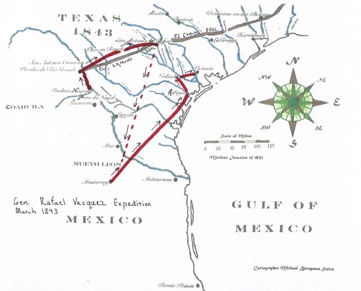
(Fig. 2) Gen. Rafael Vasquez Invasion routes for primary and secondary forces
Cartography by Michael Berryman Smith
Immediately upon return to Austin, Terrell wrote Houston of the account “the Mexican flag could be seen flying over the church steeple – and a most humiliating sight it was to a true hearted Texan to behold…” On January 9, Gen. Arista’s issued a proclamation to the residents of Texas, which was published in the Houston Telegraph and Texas Register. Arista’s proclamation said that Mexico had not consented to Texas’ separation from the central government and did not recognize her independence. Arista also said [concerning Mexican rights] through the only means left to her, that is persuasion of war. He further told Texans that it was hopeless for them to continue their struggle for independence and promised amnesty to those who surrendered or promised to use the sword of justice against the obstinate. He further said that only Mexico’s own civil war problems had kept her from dealing with Texas. (see Fig 3) Terrell decided to “go and see” San Antonio for himself and so that he could apprise the situation and properly advise Houston of the situation. Shortly after Vasquez captured San Antonio, Terrell and four other men departed Austin and traveled “within sight of San Antonio.” Arista had written to the Mexican Secretary of War and Marine, The National Flag is once again flying over the city of Bejar, and the Mexican eagles are again today treading the soil they have been deprived of the for the length of six years.[xxxviii]
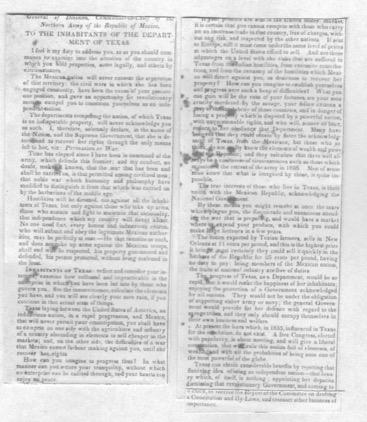
(Fig. 3) Mariano Arista Proclamation
On March 9 from Austin, Terrell penned this poignant letter to Houston:
Before this reached you, you will no doubt have heard rumours of war and invasion in their most exaggerated forms – and that both do exist to some extent, there is no doubt whether it will amount to a serious invasion, however, I still think very questionable. Gen Moorehouse has doubtless informed you of the reports which were brought here from San Antonio, of a force that was supposed to be marching upon that place, and upon which I determined to “go and see.” It was Arista’s Proclamation that made a serious impression upon my mind. Three went over, but just as we came in sight of the town we met the troops from that place, 150 in number, marching out, having abandoned it, and the Mexican flag could be seen flying from the church steeple and a most humiliating sight it was to a true hearted Texian, to behold the flag of that miserable degraded people, waving in triumph where the ample folds of the Lone Star should ever be seen floating in the breeze. It is so however – nor do I think those who abandoned the town deserve censure for its evacuation, they had no certain intelligence of the numbers of the enemy – they were variously estimated by those who did get a sight of them (and they were few) at from one to 3000 – they had no assurance that they would be sustained in a few days – and the very place they were in – constantly calling up the recollection of the fatal catastrophe that had occurred their six years before – was calculated to produce an impression upon the stoutest nerves. Capt. Hays, their commander is a gallant and chivalrous a little fellow as any in the Republic – and would have remained if could have prevailed upon one half his men to stay with him, he could not however, and was compelled to yield to circumstances.
The whole country here is, of course, in a state of alarm. Yet I do not believe there is sufficient cause for it. That this is intended by the Mexicans as a general invasion, I have no doubt. They are commanded by General Vasquez, supported by Gen Brara and Col. Corasco, all of whom are known to belong to the regular army. They are carrying out the professions of Arista’s Proclamation, they are treating the prisoners they take with great kindness, they respect private property, they have established their civil authorities in the place – elected an alacade & all which go to convince me that they calculated upon ultimate success. Whether Santa Anna can send them reinforcements from west of the mountains, however, I think very problematical. This will, of course be determined in a few days. Should they not be reinforced we can drive them from the town or take them all prisoners in less than a week from this time. Hays fell back upon the Guadeloupe and is there awaiting reinforcements to return and expel them from his town – the yeoman of the country are rallying with great zeal and promptness to the standard of their country. He has now about 300 men, and there are upwards of 400 in this place. Col. Jones is in command Gen Burleson wants very much to take 100 of the men from here and join Hays to retake San Antonio. This is opposed by Col Hockley until he gets sufficient forces to protect this place. For my own part I do not believe this place in any immediate danger. It is right however to take measures for its protection. But I believe 500 men could retake San Antonio and make the whole of those [not legible] prisoners, in less than four days’ time.
I regret extremely that you are not here. We want an efficient head exceedingly – to give both confidence and energy to our movements. I do sincerely believe that if I had command of the troops myself I could place things in a much more efficient altitude of defense. However, I will reflect upon nobody. I only regret that you are not here. If we have to exchange the implements of husbandry panoply of war – the endearments of the domestic fireside for the turmoil of belligerent strife, and the privations of the “tended field” we will stand greatly in need of an efficient head, as I believe the Congress refused to give the President authority to command in person, even in case of invasion.
If we have a general war, it will give us a great deal of trouble – but I say let them come – and I believe they could not have selected a more forward juncture for us. The excitement in the U. States on the subject of Santa Fe prisoners is so great that I have no doubt we could obtain both men and money to enable us to prosecute the war, even into the territories of the enemy. And inasmuch as they have again commanded open hostilities – it is my opinion that our policy is to keep up active operations until we extort a pearl from our haughty but imbecile foe. I do not wish this remark to be understood as recommending an invasion of Mexico – this we are not in condition to do – but we could keep up active hostilities until we would convince her that we will not tamely submit to her depredations.
Mayfield called upon me to day and held a long conversation with me. He assured me that he was ready to second you in any and all measures which may be necessary to defend the country that he will be found yielding you a cordial support to either in the field or in the congress should one be convened.
I have only to add that I await your orders to act any part or perform any service you may think proper upon me in any capacity, either civil or military, in which you may think I can be most efficient.[xxxix]
Terrell also penned a very poignant letter to an old family friend that his father Col. James Terrell served under and planted the standard for at Pensacola in August 1814, Gen. Andrew Jackson of Hermitage Tennessee, sending along with it a gift of notable significance.
10 March, 1842,
Cty of Austin,
Republic of Texas
Gen Jackson, Sir, I send you herewith a pipe as a memento of the friendship I entertain for you personally and the respect I hear your character. It is of no value of itself, and derives its only consideration from the material of which it is composed, it being associated, being carved out of the stone of the Alamo, that memorable spot consecrated by the blood of Travis and of Bowie – of Crockett, of Bonham and many other noble hearts who yielded their lives a willing sacrifice in the cause of human liberty. Such an offering, although valueless in itself, I know will not fail to be prised [sic] by one who has ever shown a willingness to pledge his fortune – peril his life, and stake his reputation, in the same great cause in which these gallant spirits fell.
I visited this hallowed spot a few days since, and found it again occupied by the same ruthless and degenerate people whose atrocious enormities are without parallel in the annals of civilized warfare. We set out tomorrow morning in search of them – our forces are rallying from every direction – and we do not intend to stop as long as our soil is polluted with the hostile tread of one of the faithless, imbecile, servile and perfidious race.
In as much as I go with the troops I am much to busied [sic] in the necessary preparations for the expedition, to say to you what I would wish. That the going down of your sun of life may be calm, tranquil and peaceful as its meridian was bright, glorious and useful, is a sincere invocation of sir.” (see Fig. 2)

(Fig. 2) Pipe Carved from Stone of the Alamo
Courtesy “The Hermitage: Home of President Andrew Jackson, Nashville, TN.”
Retributive Vengeance
On March 10th Houston issued a general call to arms. My Dear Countrymen, Houston started, Rumours have brought from the south-western frontier on invasion. Particulars have not been furnished to the Executive. The facts are sufficient, however, to justify immediate preparation for defensive war. Houston went on to order that all men who were subject to military duty were to prepare, arm and ready themselves. He further ordered the Colonel of each county lay off the county into company beats and direct the election of Captains and Subalterns. Terrell made several more trips to San Antonio and in another letter, he noted you have before this time learned through other channels all that is going on…There is no doubt however of one thing, that is, that it was an expedition against this country sent by the Mexican government… Cornelius Van Ness had told Terrell that in an interview with Col. Carrasco, he had learned that this force constituted no part of an invading army, that the Mexican troops had been sent to take Goliad and San Antonio. Terrell, on the other hand, believed that the Mexicans were induced to believe if they sent a small force they would be joined by the Tejanos and others to enable them to take possession of San Antonio and could sustain themselves until a larger army arrived, which they expected in mid-June. Houston, for his part wrote to Hockley advising him that Brigadier General Somervell would be taking command in case the brigade needed to be called into service.[xl]
The Mexican forces were informed by the Tejanos and possibly Juan Seguin, according to various intelligence reports, indicating Seguin was providing Vasquez with intelligence on the Texans, that a large force of about 1200 to 1500 men were concentrated on the Guadalupe and were preparing to attack them immediately which induced the Mexicans to retreat as quickly as they did after capturing San Antonio. On March 10, Houston also declared a national emergency and ordered the archives to be moved to the city of Houston by way of Caldwell. Terrell had advised the President some weeks prior that the citizens at Austin and Bastrop threatened to arm and prevent any attempt to move the Republics property. He further noted that if the order should be given, Hockley and he would execute it. Because of the excitement it caused, Hockley suspended the order. Houston had sent a note to Hockley ordering him to communicate to all the heads of the various departments to move the archives to Houston telling him You may find it most safe to have the archives removed by way of Caldwell o the Brazos. Further telling him, if the enemy advances upon the Colorado, they would be in danger by the way of Rutersville route. On March 12, Houston ordered Col. Alexander Somervell to assume command of the volunteers. On 13 March, Terrell, Burleson, Hemphill, Gillespie and Oury again left for San Antonio and found hundreds of volunteers coming from all across the country. These volunteers were for the most part untrained and inexperienced except for fighting Indians. However, they wanted the opportunity to avenge themselves. Somervell arrived in San Antonio on March 15 and Burleson yielded command of the volunteers to Somervell, however the Mexicans had already abandoned the town on March 9.[xli]
Vasquez and the Mexican forces had already abandoned San Antonio six days earlier. In Mexico City, Santa Anna was furious and disgusted with the outcome of the Vasquez expedition since he failed in his principle duties. Santa Anna had not sent him to occupy San Antonio, but to take it by surprise and capture or put to the knife the garrison of adventurers who had taken possession of that town. Vasquez was subsequently summoned to account for his actions at Mexico City. Secretary of State Anson Jones wrote to Secretary of Treasury, William Daingerfield:
I hope to God the President will act with promptness and energy and follow the Manifesto by deeds corresponding to the words of that instrument. I want to see in the course of six weeks Matamoras, Tampico and Vera Cruz in our power and a formidable army in the valley of the Rio Grande threatening all Northern Mexico and even Mexico herself. Then, I think, we may negotiate and settle the matter in short order.
On March 14, Houston issued his proclamation to all Texans: Let the troops be organized and wait for orders to march to any point where they may be required by the President he said. The whole force of the enemy now in Texas cannot exceed 800 or 1,000 men and that of Texas now in camp and on the march West of the Brazos must be 3500 or 4000 men. He finished by stating If the enemy do not retreat they will be taken prisoner or slain. On March 15 Houston ordered Brigadier General Edwin Morehouse to communicate to the troops now here and anxious to join the army, to take up the line and march forewith and report to Gen. Somervell, who is in command of the Army. [xlii]
The following month the order came from Mexico City for another assault on San Antonio. By March 16, Terrell felt certain that the Mexicans had already crossed the Rio Grande and Burleson had called a council which decided to not go after the Mexicans because they had no chance of catching them on Texas soil. Consequently, Terrell advised Houston that Burleson planned to send an express to him asking for orders to cross the Rio Grande. Terrell favored pursuing the Mexicans and advised Houston: It is my decided opinion that the troops ought to be permitted to cross the Rio Grande for the purpose, as you remark in your proclamation, of inflicting “retributive vengeance” upon the audacious enemy.Houston, who was tired of Santa Anna’s gasconading also sent him a letter on March 16:
You tauntingly invite ‘Texas to cover herself anew with the Mexican flag.’ You certainly intend this as mockery…You continue aggression. You will not accord us peace. We will have it. You threatened to conquer Texas–we will war with Mexico…
On March 17th, Houston wrote to the Editor of the Galveston Advertiser an editorial stating the news by express from Austin up to the 13th inst., is that the enemy have evacuated San Antonio after having plundered that place. They were layden down with baggage and march slowly. Colonel Hays is harassing them on their march… The troops from Austin and those on the frontier are marching to overtake them and beat them. War shall now be waged against Mexico, nor will we lay our arms aside until we have secured recognition of our independence. On March 18th Houston sent Somervell re-enforcing Hockley’s order of the 12th and advising him to confirm the same unless “perfectly satisfied” that the enemy are advancing a force into the Republic. In that event you will meet and beat them he told Somervell. Somervell was also given a force of two hundred men to pass the summer in service to range and spy from San Antonio to Corpus Christi, and westward. He was advised however by Houston that Texas was not in a position to invade Mexico. On March 20th, Houston sent another letter ordering the removal of the archives, this time to William O’Brien.
You will proceed forthwith by Pine Island and from there thence to Oliver Jones, Esq. on the Brazos. You will show this to Dr. Anson Jones, and request that he will come to me, so soon as possible. You will then proceed on to where you may find Colonel George M. Hockley, Sec’y of War and Mr. W.D. Miller, my private secretary, and let them know, that I desire them to come to me. If Col. Hockley is usefully employed in the army and he should think his presence necessary there, he may remain until I can learn more of our situation. No express has been received from any of the forces nor does the Executive know what is to be depended upon. Rumours are arriving hourly, and daily, but no authentic facts. I wish my secretary and all the officers of the Government. Let the archives be brought here immediately. Expresses have been sent to the East for all the troops to be in readiness. I desire to hear all the news, and to know the authentic state of the army, or the forces in the field. [xliii]
Col. Clark L. Owen had written Terrell advising him that he had 450 men and was ready to march to the Rio Grande and that in two more days there would be 300 to 400 more and they could go with at least 1500 men. Terrell knew the troops would be greatly disappointed if they were ordered back and felt that if Houston ordered them to proceed it would more than counterbalance the order to remove the archives. Before evacuating San Antonio, the Mexican troops plundered everything of value they could and loaded all the wagons and carts they could procure. This booty weighted them down considerably thus causing them to retreat at a very slow pace, traveling about eight miles per day. Col. Hockley, having intelligence, ordered all the mounted men in Austin to march with all possible expedition in pursuit and to take the troops that had gathered at Seguin. Col. Hays, who had abandoned San Antonio with his company of 150 men when the Mexicans invaded, was already pursuing and harassing the Mexicans all he could with about 60 men. The Texan force remained in San Antonio until it disbanded on April 2, 1842 when they were disbanded. The release and repatriation of the Texan Santa Fe expedition prisoners, was considered a gesture of peace and good will from the Mexican government, causing President Sam Houston to withdraw his sanction from the planned incursion. Texas Leaders mulled the prospect of pursuing the Mexicans across the Rio Grande for several weeks and Terrell remained staunchly in favor of this. He wrote to Houston again advising him news of the war into Mexico your determination to carry the war into Mexico is hailed everywhere and you will encircle your own brow with laurels bright and perennial as those that adorn the memory of Hannibal. Houston issued his Proclamation of the Blockade of Mexican Ports on March 26, stating that all ports of the Republic of Mexico on her eastern coast from Tobasco to Matamoras including the mouth of the Rio Grande and the Brazos would have an actual and absolute blockade enforced on them. On March 31, Col. Somervell wrote to Houston
I confess it is with diffidence I approach a subject on which so much may depend and yet such is my firm conviction of the great good that may result from it that I am emboldened to speak and not however in a spirit of obtrusiveness or advice but with due deference and respect and a firm reliance in your well known and truly appreciated better judgement.
This then is the subject on which I would speak. There is a well-known jealousy now existing between Santa Anna and General Arista. Could you not in your own peculiar and felicitous style, foment and excite that jealousy to open rivalry and hostility by tendering to Arista on your part as it is an executive act) the acknowledgment of the independence of the Government he may establish and also to offer him the services of a thousand or more Texian soldiers to be recruited, officered, and fought under our own flag, subject to his orders while in that service but under the rules and articles of war that govern us, he to pay the expenses of the troops and they to act offensively and defensively against our common enemy Santa Anna and the Southern portion of the Republic of Mexico; if the plan succeed it would have the salutary effect of taking the war out of our own country and erecting a barrier between us and our enemies.
There is a difficulty as to the manner of approaching Arista but that I think can be obviated by the employment of John N. Seguin for that service, he is at present in bad odour among the Texians from which circumstance he could frame a good pretext for crossing the Rio Grande and asking an audience of Arista. Whether or not Seguin would accept of such a mission I cannot say, but I should think it would give him an opportunity to retrieve his former standing that he would gladly embrace, for if he be successful it would redound to his credit in an eminent degree and establish his loyalty to Texas and if he be not successful he would be in none the worse condition. Yourself are better acquainted than I of his fitness for such a mission. [xliv]
Shall Future Historians of Texas Be Compelled to Record the Humiliating Truth
The Mexicans were not the only problem facing Texas in 1842, there were severe financial issues as well. Houston wanted to defund the Texas Navy and sell it off. Since settlers had been arriving, there had been an ongoing problem with the Indians. During the ten-year period the Republic existed it was concerned with three problems: How to get into the United States, how to keep Texas out of the hands of Mexico and how to deal with the Indians. Most all Texans were agreed upon solutions for the first two problems, however opinions differed widely on the issue of the Indians. The vast majority of Texans felt that is solution required the use of the military in order to exterminate the Indians. This faction had been led by Lamar. Lamar for his part loathed the Indian population and wanted to decimate it. Additionally, the wars with the Indians under Lamar had been very costly contributing to Texas’ financial problems. Then there was an important and influential minority that wanted peaceful relationships established through diplomacy and maintained through kindness and fair dealings. This faction was led by Sam Houston who was President for more than half of Texas’ time as a Republic. Due to the costly wars under Lamar, the Indians desired peace and “Ole Sam” was an old friend to the Indians.[xlv]
With Houston’s return to power in December 1841, so too did his “policy of peace” with the Indians return. His plan in part was to send responsible agents among the Indians. In May 1842, after returning from Galveston, Houston, knowing the need for order and civic rule asked Terrell to induce Joseph Durst and Col. Leonard Williams to go see the Indian tribes and make peace with them. Finally, he called a special session of congress to meet him on June 27. On July 1, Houston wrote to Terrell asking him to “give an opinion on the Cherokees’ title” to the disputed property in East Texas. Terrell believed the Treaty was valid for multiple reasons: first, the treaty was signed in good faith; and second, the provisional government was the only government active in Texas at the time of the Treaty’s signing, and thus it was the government de facto. This conclusion jibed with Houston’s belief that the Consultation had full power to treat with the Cherokees, and to assert that it did not was nothing more than a pretext to dishonor an otherwise valid agreement. When the Consultation issued the “Solemn Declaration” in 1835, this action represented more than a simple good faith gesture aimed at the Indians. In reality, the Solemn Declaration was meant to fulfill the obligations of the provisional government enumerated in the Plan and Powers. More particularly, Article III of the Plan and Powers stated: They [the Governor and General Council] shall have power, and it is hereby made the duty of the Governor and Council, to treat with the several tribes of Indians concerning their land claims, and if possible, to secure their friendship. Undoubtedly, the Consultation wanted to settle the Cherokees’ land claim to secure Cherokee allegiance to the Texas cause, or at the very least, to keep the Cherokees neutral during the coming war with Mexico. The Consultation made their intentions known by crafting specific language in the Plan and Powers that obliged the provisional government to treat with the Indians, by issuing a grant of territory to the Cherokees in the resolution known as the Solemn Declaration, and by incorporating the Solemn Declaration into the Treaty. [xlvi]
In August, all parties agreed to a peace council at Waco Village on October 26, 1842. While dealing with the Indians as intimately as Terrell had been, he learned they desired to meet “ole Sam,” however, they failed to attend council on that date. To address the issue of the Indians were the United States was concerned, Houston first instructed Terrell to address charge’ to the United States, Isaac Van Zandt on the matter. For his part and good relations with the Indian tribes, Terrell was referred to as “Lean Captain” by the Indians, being that he was a “tall and spare” man. His good rapport with the Indians tribes made Terrell an idea candidate for Houston to have deal with them on his behalf. [xlvii]
After Vasquez’ expedition failed in March, plans developed from Mexico City for the 2nd invasion into Texas in April. Gen. Isidro Reyes was placed in command of the Army of the North Corps at Monterey on June 4, 1842, who selected Gen. Adrian Woll for the execution of the operation. Adrian Woll was a French Mexican General in the army of Mexico during the Texas Revolution and 1836 he served with the Army of Operations of the Texas campaign. After the defeat of Santa Anna at the Battle of San Jacinto, he was sent by Gen. Vicente Filisola to hear the agreements made between Santa Anna and Sam Houston. By June 4 preparations were underway. Gen. Reyes had succeeded in storing up about 10,000 pounds of salted meat and about 480 bushels of flour at Villa Rio Grande. He had surveyed the Rio Grande line at Matamoras, then went to Lampazos on July 27. Reyes returned to Villa Rio Grande by August 8 to confer with Woll on the immediate high-level preparations for their march into Texas to take San Antonio once again. Woll’s forces would be composed of 1,082 troops with two artillery pieces, over twice the size of Rafael Vasquez’ expedition. among the Presidial cavalry 243 strong, he also had 40 troopers from the Agua Verde Company and 50 from the Rio Grande Company. Of the 122 Defensores (Defenders) were 50 from Rio Grande under orders of Capt. Juan N. Seguin, former Alcalde of San Antonio. An additional note are the 20 Cherokee and 11 Caddo Indians as scouts directed by their interpreters Vicente Cordova of Nacogdoches and Manuel Flores.[xlviii]
In early June, while Houston was making appeals to the United States for money and volunteers, Adjutant Gen. James Davis was sent to Corpus Christi to organize volunteers. at Fort Lipantitlán on the Nueces river. On June 19th Col. Antonio Canales had obtained information through his scouts that Gen. James Davis had a position with 400 Infantry Volunteers from the United States, in the service of Texas, with two horses and a cannon, encamped at the Kenny ranch on the right bank of the mouth of the Nueces and that they were waiting for another 200 on the way from Galveston, Canales ordered the of assembly for the 1st, 2nd, 3rd, and 4th Squadrons of his Regiment, which were those of Camargo, Mier, Reynosa and Guerrero respectively. On the 23rd, they made camp on the left bank of the Rio Bravo, together with the Rio Bravo Squadron. A 10-man scouting party under Capt. Blas Cavazos rode ahead the same day to survey the enemy camp and its surroundings. At Concepcion creek, he received news by two messengers from this advance party, that the enemy was at Lipantitlan, 13 leagues from the Kenny ranch, but that they had abandoned their artillery piece in the vicinity of the Laguna Madre. Davis found that a superior force of Mexicans was nearing his position before aid could arrive. It was reported to Davis that the forces led by Cols. Jose Canales and Montero had already passed the Arroyo Colorado and were rapidly nearing the Nueces. On July 6th the advance of the Mexican forces was estimated at of 200 regulars and 500 volunteers or rancheros, of whom 500 were cavalry. Cols. Canales and Montero had agreed on a method of surprising the enemy, considering the ground they were occupying. In their estimation, three assaults and one reserve column seemed sufficient to cut Davis and his forces off from the woods. The Texans were camped on a small hill just to the right of the Nueces. Davis and his forces had no cannon with which to defend themselves. Late in the afternoon Davis, knowing of his situation decided to abandon his position and fallback 200 yards to a more secure location. Canales divided his forces into; 130 men of the 2nd Battalion 4th regular Infantry, and 70 dismounted auxiliaries from the Reynosa and Guerrero Squadrons, led by Brevet Col. Ponciano Eguren would form the first column; the Mier Squadron with 105 mounted men and a light cannon, under Lt. Col. Cristobal Ramirez would be the second; and the third would consist of the Camargo Squadron of 80 men under its Commandant Matias Ramirez. The reserve column was to be formed by 42 men of the 7th regular Cavalry, and 40 from Camargo and Reynosa; the remainder being left in Agua Dulce. The First and Third columns left from there to occupy the positions that were assigned to them, namely the North and Northeast. Shortly before day break on July 7, column one and three commanded respectively by Cols. Eguren and Matias Ramirez sought to take up positions to the north and northwest of Davis’ camp. Canales and Montero accompanied the second column under Col. Cristobal Ramirez and the reserve cavalry unit towards the front of the Texans camp and took up positions at less than musket-shot from the camp, waiting there for more than an hour to hear our Infantry open fire, as they had been instructed, so that they could charge him at the same moment. As daylight and the Texans began to awake one of them who walked out with a torch, discovered the Mexicans and roused the others. Canales and Montero signaled the infantry, Mier cavalry and the reserves charged. A brisk exchange of gunfire on both sides kept up for several minutes but the distance was too great to affect any harm. Davis and his forces ceased fire but did not leave the protection of the ravine they were holding a defensive position in. About mid-afternoon, the lone Mexican artillery piece brought by Col. Montero was advanced to a position about two hundred and fifty yards to the left of Davis, however, rifle shot rang out, killing the commander of the artillery piece. Canales and Montero both reported that the piece was disabled from the carriage after its first shot. However, Gen. Davis was able to repel the invasion and Canales and his troops retreated back across the Rio Grande into Mexico. [xlix]
In an attempt to raise money to finance a war and invasion of Mexico, an idea that many Texans desired, the legislature drafted a bill to appropriate ten million acres of land. Houston vetoed the bill however and Davis was dismissed. By the summer of 1842 tensions were high, nerves were frayed and no less than two important patriots in the annuls of Texas history were contemplating resignation. In June 1842, Houston had become increasingly disgusted with the problems facing Texas and was considering resignation. Confiding in his old friend, Gen. Terrell, Houston brought about a swift and epic rebuke from Terrell who perhaps played a major role in averting such an inconsiderate and ruinous step. In July 1842, Terrell was set to move himself, his wife Barbara and two sons, Sam Houston Terrell and James Epaminondas Terrell from San Augustine County to Houston but due to Mrs. Terrell’s apprehensions that move didn’t occur but by July, Terrell was in Houston for the sitting of Congress. In a letter to his wife Margaret, Houston noted that Judge Terrell has gone to move his family to Houston so that you will soon, I hope, have the pleasure to meet and embrace his excellent and pious lady. On July 5, 1842, Terrell penned, perhaps the most important letter to Sam Houston that he would ever pen. Not being a pithy man, he went to great length to impress upon Houston the seriousness of his actions, should he take them. Will you disappoint the expectations thus excited in the bosoms of your confiding countrymen Terrell asked, Shall future historians be compelled to record the humiliating truth; shall it be told to posterity at such a time, and under such circumstances, the man who by common consent of mankind had acquired the name of benefactor to his country, had abandoned that country and flying for his own safety had left her to be devoured by that hydra headed monster to whom she was thus an easy prey? wrote Terrell. He also reminded Houston that upon his election Texas was also surrounded with “inveterate and implacable” enemies upon her borders and that “insurrection and insubordination to the laws stalked abroad in the land.” Because of the issues that the Republic faced, the eyes of the whole nation were turned upon Sam Houston who had led the Texans through the gloomy period of the revolution as the only man who could extricate the country from this complication of evils under which she found herself. Lastly, he urged Houston to think about his own reputation, telling him that his character is inseparably identified with the history of Texas and as the pages are bright or shaded or dark will the political character of Sam Houston take its hue. In one of the first conversations Houston and Terrell had about the formation of the executive’s cabinet after the election of 1841, Terrell told Houston that if he succeeded in extricating the Republic from the difficulties and embarrassment under which she was in, due in part to Lamar’s deplorable managing of the country, his name would go in posterity upon the same page as Washington, Jefferson and Jackson. For Houston’s part, he felt that Texas and the world would do him justice to his motives and acquit him of censure. Terrell obviously was of a different opinion and believed that those who knew Houston and could appreciate the difficulties which surrounded and embarrassed him would no doubt do him justice, though he doubted they would acquit him of blame. Being wise and learned man however, Terrell knew that it was impossible that the world at large would know the difficulties and many embarrassing circumstances with which Houston was surrounded and would only know that he was the head of a nation and when calamities and misfortune pressed upon Texas that Sam Houston had abandoned her to fate and left her to the mercy of a powerful and merciless enemy who threatened her from without and a set of politicians within her more heartless and ruthless than foreign enemies. Exactly why or what the reasons were that caused Houston to give such serious thought to resigning as President of the Republic of Texas in the summer of 1842 is not quite known. William Bollaert noted in his diary that; General Houston may resign, annexation to the States may take place – but Mexico will never count Texas amongst its provinces again, Terrell did outline many reasons that could cause Houston to consider resigning but perhaps the reason lies in a letter from Houston to the Texas Senate on July 8, 1842, in which Houston defends himself from accusations made in a secret report to that body by Alexander S. Wright on March 18, 1840 saying that Houston had received information that he and an unnamed associate were paid the sum of $100,000.00 for the release of Santa Anna to which no evidence of this accusation was ever presented.
[Authors note – I have included a complete transcript of the original letter found in the Texas Archives below]
Terrell to Houston
City of Houston
July 5th 1842
Gen. Sam Houston
My Dear Sir
I have concluded to throw a few reflections, upon the present condition of our affairs into the form of a letter – for your perusal and consideration at your leisure. At a time like the present, when not only her best interest but the very existence of the country as a nation stands poised upon the action of her governors – it is the duty of every patriot to speak out boldly and without reserve. Influenced by the considerations – and prompted also by the peculiar relation in which I stand to yourself as the chief magistrate of the nation, I feel it my duty to say to you, in great frankness, that you were contemplating a measure which, if carried out, must, in my opinion, end in the prostration, if not the entire destruction of this poor, distracted country. I allude of course to your purpose to resign the office of President of the Republic. So thoroughly am impressed with the apprehension of evil consequences which must inevitably result from that inconsiderate and ruinous step, if taken, that I have determined to leave my recorded remonstrance against so ill advised and fatal a measure – that all may know I have discharged my duty to my country in this her hour of tribulation.
You know that I am no flatter, therefore you will not suspect me of any such unworthy motive, when I say that in the present trying crises of our national affairs – there is no other man that can save the country from that ruin which seems so fearfully impending over us, threatening destruction to the political institutions of this favoured spot of Heaven’s creation. You have been called by the almost unanimous voice of the people, to preside over the destinies – and to guide the councils of this nation. The difficulties with which you have been to contend were, in a great measure, known and foreseen when you were called to the head of affairs. It was then known that the National Treasury was without a dollar – that the resources of the country were exhausted – confidence destroyed at home – public credit abroad prostrate – in short that the Nation was bankrupt. That we were surrounded with inveterate and then implacable enemies upon our borders – that insurrection and insubordination to the laws stalked abroad through the land – in a word – that we were reduced to the very lowest point of National degradation. In this state of things, the eyes of the whole nation were turned up on Sam Houston, upon him, who had led through the gloomy period of the revolution – as the only man who could extricate the country from this complication of evils under which she laboured. Will you disappoint the expectations thus excited in the bosom of your confiding countryman? Shall the future historians of Texas be compelled to record the humiliating truth that in the hour of her utmost need – at the gloomiest period of his country’s history – in the darkest hour of the nation’s travail – when all eyes were turned upon you, as the only man living who could work her deliverance from this state of thralldom and bondage – and when also the eyes of all surrounding nations were riveted with fixed and intense interest, gazing with wonder and admiration upon the mighty efforts of the youthful Hercules for the deliverance of his country from the fangs of the political Python that had enveloped her within his Anacondan folds – shall it be told to posterity at such a time, and under such circumstances, the man who, by common consent of mankind had acquired the name of benefactor to his country, had abandoned that country and flying for his own safety had left her to be devoured by that hydra headed monster to whom she was thus left an easy prey? Forbid it patriotism! In memory to your own reputation may kind Heaven avert the dire calamity.
What would the world say of the Captain of the vessel who although he had put to see when a storm was gathering, yet when the tempest grew angry – the winds began to howl fearfully around him and drive him amongst rocks and breakers would take to his long boat and securing himself a safe retreat into a smooth harbor leave his vessel and crew to the mercy of the wins and the waves? This is precisely our present situation. You assumed the helm of the vessel of State when a political storm was already lowering above our heads. That storm has increased its fury and is now bursting in wrathful fierceness upon our little baroque the howling of the winds and the roar of the waves are indeed terrific – shoals, rocks and breakers surround her on every side – wide the foul tempest is still driving her fiercely forward with unmitigated fury. This is the state of things well calculated to appall the stoutest hearts and must cause fearful apprehension in the breast of every patriot. Still, the dictate of patriotism is in my opinion to nerve itself with restitution and firmness to meet the crises and to rise with the strength proportionate to the difficulties with which it is surrounded – as an arch becomes more firmly united by increased pressure an acquires strength in proportion to the weight which is accumulated upon it.
I will lastly urge upon your consideration and argument which should always weigh much with every man – I mean a regard for your own reputation. Your character is inseparably identified with the history of Texas and accordingly as the pages of that history are bright or shaded or dark will the political character of Sam Houston take its hue. I recollect saying to you, the first conversation we had with regard to the formation of your present cabinet that if you should succeed in extricating the country from the difficulties and embarrassment under which she was then laboring – your name would go down to posterity enrolled upon the same pages with those of Washington, Jefferson and Jackson. She is now in even greater straights than she was then. Should you stand by her in this her hour of greatest need and rescue her from this her greatest peril – latest time shall rest from dark oblivion the name of Houston and ever preserve it in characters of living brightness on the records of imperishable fame.
You are of the opinion that the Nation and the world will do justice to your motives, and acquit you of censure – I think differently – those who know you well and can appreciate the difficulties which surround and embarrass you, would doubtless do you justice – though I doubt whether they would acquit you of blame: but Sir, the world at large, and more especially posterity – for whom the founders of Nations always live – will not hold you guilty for such an act. It is impossible that they should know the difficulties and many embarrassing circumstances with which you were literally environed – they will only know that you were at the head of the nation, and that when calamities and misfortune pressed upon your country on the hour of her deepest distress – you abandoned her to her fate, and left her to the mercy of a powerful and merciless enemy who were threatening her from without and a set of political cormorants within her own body, still more heartless and ruthless then foreign enemies. The effects of these impressions would be blasting and withering to all those hard – earned laurels the rich rewards of so man, privations, tails and hard-fought battlefields.
These reflections might be extended without effort into a volume – as the arguments press upon me as I —– I fear however that I have already taxed your time and patience to heavily and will bring them to a close with the explanation of a hope that you will pause long and reflect deeply upon the calamitous consequences which must inevitably result to your country from so hasty, injudicious and disastrous a step. Although our country is at present in a most deplorable condition one calculated to excite gloomy (not legible) in the mid of every patriot I have the fullest confidence that a firm front presents to the difficulties which surround us and a steady perseverance in the course of policy thus far pursued by the present administration, will yet safely moor our little bark in the shaping of nation repose – and that honour, peace and prosperity will ere long smile around and brighten the gloomy prospect with which we are at present surrounded.
Your devoted
G.W. Terrell [l]
Under Mirabeau B. Lamar “red backs” were issued by an act in January 19, 1839. It provided for promissory notes payable to bearer and without interest and they were issued in denominations of $5, $10, $20, $100, and $500, with change notes of $1, $2, and $3. By 1842 Houston advocated the issue of a new type of currency. Congress by an act of January 19, 1842, provided for the issue of “exchequer bills” and the summer of 1842 they had sunk to as low as twenty-five cents on the dollar. There was virtually no use made of them by the public except for payment of taxes. On February 3, 1841, the Texas Congress authorized the firm of McKinney, Williams and Company, a mercantile establishment founded by Thomas F. McKinney and Samuel M. William to issue notes for circulation as money, using it for security on mortgages for real estate, slaves, and a sawmill. When finally organized in 1847, the “Commercial and Agricultural Bank” was the first legal bank established in Texas. On June 12, 1842 Terrell advised Houston on the issue of exchequer doing well in the eastern counties but that some are endeavoring to depreciate the currency.
My Dear Gen
I shall not be able to return as soon as I contemplated in consequence of my wife’s declining to go to Houston – she is afraid to go there to spend the summer, and not being without apprehension myself, I shall not insist upon it, lest some fatal accident should occur, and I should reflect upon myself for having carried them there. For this reason, I shall remain with her and get to Houston before the sitting of the Congress.
There is no excitement here on the subject of the war, consequently very little animation in raising volunteers. I think however the number required will be raised in all the surrounding counties, except San Augustine, they say the call upon their county is too heavy for their population – they only have 480 men subject to militia duty, and near 200 of them are called out – as many as in this county or Shelby, both of which are much stronger.
Exchequer money is in good repute in this part of the country – rather in demand in Augustine (they pay some duties there) passing at par – and some of the merchants at Nacogdoches take it at par also – some other are endeavoring to depreciate it. I have no doubt if there is not another issue made it will be at par all over the county in two months from this time. I very much fear however, if you issue enough of the new stamp bills only to redeem the old, that the impression will be made abroad that there has been a large amount thrown into circulation for the sole purpose of depreciating it. It is now known that the printed bills have been long since exhausted and the impression that any more of them is to be issued cannot be made and although they look a little badly yet I cannot that circumstances affects their credit, and my reason for it is the Houston ___ pass currently everywhere through the county, and yet many of them are so defaced that they cannot be read – printed upon very rotten paper – they are better here than the money of McKinney & Williams – which is conclusive proof with me that is the opinion of the community as to the solvency of an institution and not the paper upon which money is printed that stamps its character or gives it currency. Therefor I believe, notwithstanding we are all half starving for want of money and as to myself my credit is materially indeed for want of a few hundred dollars, yet I believe it to be the only policy for the country that we do without and not issue a dollar until it gets entirely up throughout the Republic [li]
The problems facing Texas in 1842 were indeed serious. The difficulties Houston had to contend with were known, and foreseen when he was elected President. The national treasury was without a dime, the “red backs” and the newly minted “exchequer” were worthless and the resources of Texas were exhausted. Confidence had been destroyed under Lamar. During Lamar’s administration, Indian relations were completely dismissed as he disliked the Indians and wanted them destroyed or gone. This contempt played a major role in depleting the treasury by financing many battles with the Indians, destroying public credit and bankrupting the Republic both morally and fiscally.[lii]
Old Friends Should Not Split Over Trivial Causes
During the whole of 1842, Santa Anna’s overall goal was to provoke Texas into an invasion of Mexico, which Santa Anna believed he would crush the Texans. His constant harassment along the Rio Grande and two full scale invasions of San Antonio with quick retreats, tested the nerves of Houston. It had Texans in constant fear and Texans by and large were clamoring for invasion and retribution. This, of course, was exactly the response Santa Anna was hoping for. Initially Houston delayed, knowing Texas could not survive another war. On 24 August 1842, Woll’s expeditionary column marched out of Rio Grande in the direction of Nogal Pass on the Rio Bravo then proceeded some 30 kilometers northwest of Rio Grande. Woll, for his part did not proceed directly east as Vasquez had done but followed the river roughly to where Rio Escondido empties into the Rio Bravo just south of present day Eagle Pass in order to take San Antonio by surprise. Woll reported to Santa Anna that the forces had arrived at Leon Creek at 2pm on September 10 “at approximately three leagues (12 miles) distance from San Antonio” Upon reaching the San Pedro Creek, a halt was called and detachments of Bejar and Rio Grande Defensores and of presidial soldiers were dispatched to the Alamo and all exits from the city were secured, cutting off all avenues of escape and San Antonio was secured by midnight. By September 11, San Antonio was once again under the control of forces sent by Santa Anna. Woll wrote:
Our march was made across the desert, overcoming all obstacle’s, cutting open road through the forest, traveling the head of the Ugalde (Uvalde) Canyon, and following the Ugalde Canyon and the slope of the San Saba hills so that the Texan scouts, reporting from the Leona and the Nueces River (crossings) that no sound could be heard along the customary roads to confidence to such an extent, that the Court Justices appointed by the so called government of Texas, had arrived to open Court sessions. [liii]
Part of Woll’s plan was for Captain Juan N. Seguin to occupy San Antonio with the remainder of the Bejar and Rio Grande Defensores. In a report dated September 20, from Woll to Secretary of War and Marine, Isidora Reyes about Seguin he stated;
Mr. Juan Nepomuceno Seguin, did likewise fulfill this time what he had offered to the government, and what his friends had expected of his steadfast character and his well accredited valor; having drawn his sword, he fights under the Mexican flag, and the Fatherland can expect a great deal from this honorable citizen in the forthcoming conquest of the usurped territory, with his talent, bravery and vast knowledge of the Department of Texas; I beg Y.E. to recommend earnestly to the Supreme Government, the merits of Mr. Seguin,
On September 14,1842 from his camp on Cibolo Creek, Juan Seguin sent a dispatch to Woll telling him;
The scouts on the left flank, under the command of Don Manuel Carbajal, lieutenant of the first company of the Defenders Regiment discovered on Cibolo Creek two leagues from this road three Texans and a Mexican who, having been ordered to place themselves in obedience to the supreme government, instead of doing so grabbed their weapons and attacked the detachment. The scouting party, giving battle, killed the three Texans, excepting the Mexican who from the first placed himself at the disposal of the Supreme Government and remains with the detachment. I have the honor to tell Your Lordship that two thirds of the horse herd belonging to Captain Francisco Herrera’s squadron has arrived here tired. The same is true of the greater part of mounts belonging to the Defenders under my command. Despite this great obstacle, we continue our march in order to carry out, as well as may be possible, Your Lordship’s superior order. In making this communication to Your Lordship, we have the honor to offer our consideration and respect. God and liberty. Juan Nepomuceno Seguin [liv]
It was reported that Woll’s forces consisted of 1300 Calvary and artillery that captured and occupied San Antonio. The surprise attack caught the members of the Bar and a Judge of the District Court in session. About 60 Texans, including the Mayor of San Antonio Samuel A. Maverick were captured. On September 15, the captured Texans were forced to march towards the Rio Grande en route to Mexico City with a guard of 150 Mexican soldiers. They were forced to march for three months, finally stopping at San Carlos Fortress in Perote, Veracruz. Although the journey was difficult, the men were often forced to sleep in manure-filled sheep pens, according Maverick who wrote that he saw and experienced a thousand new thrills.‘ Hearing of the news, Houston authorized Somerville to take 700 volunteers to the southwestern border as a show of force. [lv]
The Mexicans continued raids into Texas and the stalling on Houston’s part to commit to war with Santa Anna, as well as Houston’s policy on the Texas Navy, and in-particular his wanting to sell the schooner Zavala finally drove Secretary of War George Hockley to submit his resignation. On the evening of 31 August, Terrell spent the evening trying to convince Hockley to reconsider. Terrell, however, was unsuccessful in convincing Hockley that resignation was not an option at this time in Texas’ future. He told Houston that Hockley felt as though Houston had called into his question Hockley’s decision to suspend the order to move the archives. Terrell told Hockley that Houston was incapable of either “falsehood” or “duplicity.” That however, did not satisfy Hockley. Terrell was very disturbed over this situation as Hockley not only played an important role in Houston’s inner circle but felt that “old friends should not split over trivial causes.”
On 1 September Hockley submitted his resignation. Houston was very upset over this decision and sent a reply to Hockley asking him to not resign and a second message to Terrell pressing him to speak to Hockley again. Your resignation was handed to me by Captain Oliver. I regret that you sent it Houston wrote Hockley. Houston would have preferred to have had a personal interview. He went on, I send by our mutual friend, General Terrell (as only he knows of it from me) your resignation, with the desire that you will, upon review of circumstances, retain it, and continue to discharge the duties of the Department. Terrell responded back to Houston that he had received his note and had written one himself stating If has taken his determination to leave the cabinet, I seriously regret it. The damage was done however, and Hockley resigned as Secretary of War. [lvi]
With Hockley’s resignation, Houston was in need of a new Secretary of War. In conversation with Houston on filling the positon left open with Hockley’s resignation, Houston mention Gen. Memucan Hunt. Hunt had previously served as Secretary of War and Marine under Mirabeau B. Lamar from December 13, 1838 – May 1839. Houston and Hunt were not exactly on friendly terms however. Hunt approached Terrell on September 3 about the job. Terrell told him that he would be the first person that the President would look to fill the vacancy left by Hockley. Hunt asked Terrell if he was authorized to advise Hunt of this to which Terrell responded he was. Hunt informed Terrell that this information had changed his attitude towards Houston but, he could not accept any position unless there was war. Later that evening, Hunt once again met with Terrell and advised him that after speaking with several friends on the subject that he would be willing to accept the position provided Houston would pledge himself to carry the war to Mexico and would enforce the blockade rigidly. Terrell told Hunt that the President would make no such promises since there were ongoing mediations by “foreign powers” between Texas and Mexico. He said that until the outcome of those negotiations was finished, and the outcome known, no general war could be waged. Because Houston could not pledge himself to Hunts terms, Hunt would not accept the position. Houston then chose Dr. George Washington Hill to serve as is Secretary of War who started that position on January 16, 1843 until the end of Houston’s second term. [lvii]
In mid-September, Mathew Caldwell formed a militia of 210 volunteers’ men marched toward San Antonio. Caldwell and his troops made camp about twenty miles east of San Antonio, near Salado Creek, and planned their attack on the Mexicans On September 17, Caldwell sent a group of rangers to draw the Mexicans toward the battlefield he had chosen. On September 16th, Joshua D. Brown, who rode under Captain “Black” Adam Zumwalt’s command, rode in company with Private Tilberry who was the bearer of a dispatch from Captain Dawson to Colonel Caldwell. J.D. Brown was one the volunteer details sent by Colonel Caldwell to the scene of Dawson’s Massacre and that he, with said detail, found the men of Dawson’s command “yet warm in their blood upon the field of battle.” Around 1,000 Mexican Army began to chase the men out of San Antonio to attack them. Caldwell united with Capt. John C. Hays’s ranger company of fourteen men, that had been driven from San Antonio with Woll’s approach. Caldwell, wanted to precipitate a fight, but his forces were not strong enough to attack the Mexicans in San Antonio. Having ordered the start of the return march to Rio Grande on September 18th, Woll “considered having fulfilled the mission entrusted to him, having succeeded flying the Mexican flag once more. Simultaneously, Caldwell dispatched Hays’s men into the town at sunrise to draw out the enemy.
The Alamo Mission bugle signaled the approach of the enemy and Woll ordered his troops to give chase, “until reaching the Salado Creek at a distance of three leagues (12 miles) from the city,” Woll reported to Gen. Reyes September 26. “the Texans suddenly veered off into the woods, and I learned that they had assembled at a strength of about 300 men under Col. Caldwell.” For his part, Caldwell believed if Woll could be lured into the open prairie, the Texans, could put up a good fight from their defensive position in the bed of Salado Creek. Hays, Henry E. McCulloch, William A. A. “Bigfoot” Wallace, Robert A. Gillespie, and thirty-four other Texans, arrived a mile from San Antonio between nine and ten o’clock in the morning and prepared an ambush. Hays and McCulloch then took six men with them and ventured to within half a mile of the Alamo, taunting the Mexican cavalry to come out and fight. Hoping to be pursued by about forty or fifty Mexicans, Hays and McCulloch were instead chased by about 400 to 500 cavalrymen toward Salado Creek. Woll had just completed preparations to move against Caldwell with his whole force of cavalry in the saddle when Hays and McCulloch made their appearance. Woll said he would go in person and drive the Texian wolves from the bushes. He rode out with nearly his whole force, to attack Caldwell’s position. Caldwell sent out a call for help. The enemy are around me on every side, but I fear them not, he wrote. Vowing to hold his position until reinforced he told Texans It is the most favorable opportunity I have seen…I can whip them on any ground, without help, but cannot take prisoners. During the day’s fighting, the Texans reportedly killed sixty Mexicans and many more wounded, while only one Texan was killed and nine to twelve were wounded. Among the Mexican slain was Vicente Córdova, leader of the abortive rebellion of 1838.
While enjoying a resounding success at Salado Creek, Caldwell had sent 54 Texans separately, under the command of Nicholas Mosby Dawson, to advance on the rear of the Mexican Army. Woll, afraid of being surrounded, sent 500 of his cavalry soldiers and two cannons to attack the group. The Texans had a fighting chance against the Mexican rifles, but once the cannons were within range, their fatalities mounted quickly, and Dawson realized the situation was hopeless and raised a white flag of surrender. As the fighting raged on both sides, Dawson was killed. The battle was over after a little more than one hour. At the end of the battle, 36 Texans were dead, fifteen captured and two escaped. At the front, Caldwell’s men had repelled the Mexican Army and inflicted heavy casualties.
On September 21, Woll’s forces met up with a few Texas Rangers at Hondo Creek where it meets Quahi Creek which was the site of the Battle of the Hondo Creek. The Rangers were part of the Texas forces, under the command of Hays, after the success at Salado Creek. The Rangers attacked on the banks of the creek, and a battle ensued. Four Rangers were wounded. The Rangers captured a cannon battery but had to abandon it, as the Texas Army did not advance to their position. Caldwell believed that his men could overtake the Mexican Army. However, the Texas forces were outnumbered, under-provisioned, and facing fierce cannon fire; they lacked a consensus, and the leaders were unable to rally unanimity for an offensive action.
Following the battle, the Texans disbanded and Woll was forced to retreat to San Antonio and then towards the Rio Grande. With the retreat, Woll had the prisoners that had been captured upon entering San Antonio. Mayor Sam Maverick kept a journal while a prisoner, giving an account for the journey to Perote Prison. We cross pretty Leona and the Nueces and camp on the head of laguna de Espantosa, seven miles west of the Nueces. He wrote on September 19. On the 20th, they crossed the Rio Grande in two canoes. Horses made to swim, three or four drowned. Men astonishing swimmers. They crossed at the upper crossing at the lone pecan tree on the east side. River about 350 yards wide. Then by September 23 they proceeded the four miles to Presidio Rio Grande. Water plenty but salt and unfit for drinking. Sheep and cattle around. Old mission (San Bernardo) east of town. Town old. good labores (farm lands) northwest of it and on almost all the way to San Fernando (de Rosas.) On September 27. Passed through a rich irrigable prairie all the way to Nava before reaching which we saw thousands of acres of corn without fence. Soldiers say this land is public.[lviii]
Silly Taunts and Idle Threats of Braggadocio
By October 1842, Houston, his cabinet, his military leaders and militia leaders and Texans at large were tired of the constant harassment by Santa Anna and were determined to bring about an end to the silly taunts and idle threats of braggadocio and gasconading proclamations. On October 3, 1842 Houston ordered Alexander Somervell to organize the militia and volunteers to invade Mexico. Houston wrote to Somervell:
Sir, Your official communication from San Felipe under date of 29th ultimo, reached me late last night. I seize the first mo ment to communicate my orders. You will proceed to the most eligible point on the South Western frontier of Texas, and concentrate with the force now under your command, all troops who may submit to your orders, and if you can advance with a prospect of success into the enemy’s territory, you will do so forth with. You are at liberty to take one or two pieces of ordnance now at Gonzales. For my own part, I have but little confidence in cannon on a march ; they will do on a retreat, where the forces are nearly equal, but they embarrass the advance of an army; and if pressed hard on a retreat, the great aversion that troops have to leave their artillery, may induce delay, and embar rass all the movements of the army. Our greatest reliance will be upon light troops, and the celerity of our movements. Hence the necessity of discipline and subordination. You will therefore receive no troops into service, but such as will be subordinate to your orders and the rules of war. You will receive no troops into your command but such as will march across the Rio Grande under your orders if required by you to do so. If you cross the Rio Grande you must suffer no surprise, but be always on the alert. Let your arms be inspected night and morning, and your scouts always on the lookout.
You will be controlled by the rules of the most civilized warfare, and you will find the advantage of exercising great humanity to wards the common people. In battle let the enemy feel the fierceness of just resentment and retribution.
The orders of the government of the 15th ult. having been disregarded by those who have gone to Bexar, in never having reported or communicated with the Department of War, the Executive will not recognize their conduct, and you alone will be held responsible to the government, and sustained by its resources, you will report as often as possible your operations.
You may rely upon the gallant Hays and his companions; and I desire that you should obtain his services and cooperation, and assure him and all the brave and subordinate men in the field, that the hopes of the country and the confidence of the Executive point to them as objects of constant solicitude. Insubordination and a disregard of command will bring ruin and disgrace upon our arms.
God speed you.
I have the honor to be your obedient servant, Sam Houston.
He then had Terrell, who was acting as Secretary as State in the absence of Anson Jones, to address the governments of Great Britain, France and the United States. about the ongoing issues and problems Texas was having with Santa Anna and the Mexicans. Terrell crafted a wordy yet powerful address to the three countries about the mode of warfare that Mexico was waging on Texas during 1842. It was the view of Texas leaders that the “character of hostilities” waged by Mexico against Texas violated the principles of warfare, since the Declaration and the establishment of Texas had never made a formidable effort to do so. Terrell deemed Santa Anna’s principle of war to consist of silly taunts and idle threats of braggadocio and gasconading proclamations. The threats of invasion had resulted in nothing more than fitting out and sending into the most exposed portions of Texas petty marauding parties for the purpose of pillaging and harassing the weak and isolated settlements on the western border. Terrell further explained that since March 1842 no less than three incursions had been made. The first was composed of artillery, infantry, rancheros and Indian warriors upon San Antonio. The second of which attacked a party of about two hundred immigrants at Lipantitlan and the third under Gen. Woll which took San Antonio a second time and surprised a session of the District Court and it was composed of regulars, rancheros and Indians.[lix]
Texas, who was still in the early stages of Indian rapprochement, was particularly distressed by Santa Anna’s employment of Indian bands originally from the United States but located within the limits of Texas. The Texas leaders always refused to employ the services on Indians when fighting against the Mexicans and had sought every possible means to mitigate, rather than increase the calamities of war. What was most deplorable in a war of this character was the “un-offending and defenseless” became victims of the most recent cruelty and invasions perpetrated by Santa Anna. During a leave of absence, due to illness by Anson Jones, Terrell was acting Secretary of State. In that capacity, he was instructed by Houston to address the United States via, Charge d’ Affairs to the United States, Isaac Van Zandt on August 19`.
The various tribes of Indians inhabiting the Northern and North Eastern frontiers had regular business between those tribes and the citizens of the United States adjacent to them that was highly detrimental to the Texas population. The tribes were hostile to Texas, but upon terms of amity and friendship with the United States. The Indians found a ready market for the plunder that they were robbing from Texas citizens as well as securing a safe retreat, if pursued by the Texans. Attempts were being made, and commissioners had been appointed to bring about friendly relation with the Indians. However, as long as there were incentives to commit hostilities, those tribes bordering on the United States problematical. It was believed that if those inducements for them to continue hostilities against Texas were removed, the Houston administration would have little difficulty in bringing about adjustments of existing problems with the Indians. Texas was demanding of the United States to interject all trade between the Indians residing within Texas’ territorial limits and her citizens, and also give them good reason to understand that they could no longer find asylum within the jurisdiction of the United States when they have committed aggressions upon Texas and her citizens.
The object of Mexico’s hostile demonstrations had consisted exclusively in the clandestine approach of small bands of rancheros, comancheros and Indians from the Valley of the Rio Grande, for plunder and theft, although it sometimes was associated with fragments of the Mexican Army and composed for the most part by convict soldiery. They of course were not fit for anything honorable in enterprise or magnanimous in their conduct. The character of the operations conducted against Texas on the part of Mexico plainly violated every principle of civilized and honorable warfare, yet, at the same time did very little to achieve the stated object of war, which was the re-conquest of Texas. For his part, Houston hoped that the governments of friendly nations would feel not only justified, but even called upon to interpose a high authority and arrest their course of proceedings and require of Mexico to either recognize Texas independence or to declare formal war upon her according to the rules established and universally recognized by civilized nations. Texas leaders felt that if Mexico believed she was able to re-subjugate Texas, that she had a right to make the effort and that Texas would “bid her welcome.” Texas leaders and Texans in general were by no means against war with Mexico by this point in 1842. They were willing, at any time, to stake their existence as a nation in war conducted on Christian principles. They were however opposed to the unholy, inhumane, and fruitless character it had assumed, and she still maintained, which Texas felt violated every rule of honorable warfare.
Towards the close of October the troops ordered out by government began to arrive and everything gave promise of the expedition’s going on. Shortly after November 4th, General Somervell finally arrived at Bexar with Adjutant General John Hemphill, and steps were taken for the organization of the troops and putting everything in order. About ten days or two weeks were spent in organizing two regiments. During the mobilzation there where were no less than twelve hundred men ready for the march when General Somervell ordered it. General Somervell’s plan for the organization was as follows, he appointed Captain John Coffee Hays to the command of the spy company, and at Captain Hays’ request, Captain Samuel Bogart was detached with his company to cooperate and act in concert with him with his company of spies. These two therefore were placed in front as the two spy companies. At the time the two companies united. The next step taken by General Somervell was the organization of two regiments. Colonel James R. Cook was elected to the command of one, and Colonel Joseph L. Bennett took command of the other.
Samuel Bogarts muster role was comprised of; Lt. Chambless, Little, E. D. Niman, Thomas, Day, Henry, Charles, Rufus, Ashmore, John, Ayers, F. W., Bailey, Thomas, Bennett, Samuel, Bogart, C. H., Browning, Jackson, Calvert, Ν. Η. and Privates; Chappie [Chappell], George, Chappie [Chappell] N.J., Deen, W. B., Demoss, G., Dobson, Trimmier, Edney, N. J., Edney, William ,N.J., Ferrell, John, Foster, J. W., Gilliland, Thomas, Harber, George W., Hardeman, William, Hargrove, William, McDade, James W., McDade, John, Marshall, Joseph, Medews [Meadows?], Donal[d], Michel, John, Middleton, Thomas, Ravill, B. F., Reynolds [Rennels], H. A., Stephens, J. M., Stephens, John, Stephens, Thomas, Stribling, James and Tremmer, John
On November 7th, Gen. Reyes entered the Rio Grande with the 2nd Division and a reserve brigade, roughly fifteen hundred men strong. Terrell and other Texas leaders had converged on San Antonio with a clear intent of invading Mexico through Laredo. November 11, Reyes reported from San Fernando de Rosas that he had news of 1600 Texan adventurers with six artillery pieces organizing in San Antonio. By November 25th, Somervell had organized about 700 men when the expedition left San Antonio for Laredo. Houston, who had a long relationship with, and knew the Indians very well, wrote to Somervell on November 23 stating: The most efficient force of the enemy will be at Presidio. You will find the Cherokees and the warriors associated with them the most efficient force and dangerous enemy that you could encounter on the other side of the Rio Grande. He further warned Somervell They are located in the neighborhood of Presidio. [lx]
On December 1st, Reyes reported that he had intelligence of the Texans leaving San Antonio on November 25 with one artillery piece. He declared his intent to move his 2nd Division and the reserve brigade to take up positions at Las Adjuntas. On December 5, Gen. Reyes sent word from Paso del Aguila that he had been encamped there since December 3, from which he could equally well strike out toward San Fernando, or else toward Villa Rio Grande, depending on the movement of the Texan adventurers. Somervell’s expedition chose the more lightly defended towns of Laredo and Mier.
After receiving word of Somervell’s appearance December 7 at Laredo, Reyes considered it advisable to leave his camp at Paso del Aguila and return to Villa Rio Grande where he arrived on December 10th at the head of his force. By December 8th, Somervell and his militia captured Laredo, but about one hundred and eighty-five men returned home leaving Somervell with a little over five hundred men. Recognizing the expedition to be a failure, Somervell ordered the rest of the men to return home by way of Gonzales. This order left about 300 men greatly disappointed. The volunteers that wanted to continue into Mexico moved down the Rio Grande to a campsite where they selected William S. Fisher as their commander. Under his command, they would continue on to Mier in what became known as the Mier Expedition.[lxi]
The expedition set out for Mier on December 20. Thomas J. Green and about forty men floated down the Rio Grande in four vessels they captured near Guerrero. Ben McCulloch and a small group of Texas Rangers served as spies and operated along the west bank of the river while the main body of men under Fisher went down the east side of the river. On December 22 three hundred and eight Texans reached a place on the east bank of the Rio Grande opposite of Mier. They discovered that Mexican troops were assembling along the river and McCulloch advised against crossing. When the men refused his advice, he abandoned the spy company and the sheriff of Refugio County, John R. Baker succeeded him. On December 23 Fisher and the remainder of his men crossed the Rio Grande and entered Mier unopposed. The expedition was in need of food and supplies and a requisition for supplies was levied against the town and fulfilled later that afternoon, however there were no means to transport the goods to the river.
The mayor of Mier promised to have the supplies delivered the following day, which compelled the Texans to withdraw however they took the mayor prisoner to insure the delivery of the supplies. All day on December 24th the Texans waited on the supplies, but, unbeknownst to them at the time, Gen. Pedro de Ampudia had arrived at Mier and had prevented the supplies from leaving, which Fisher learned about on December 25th. In desperate need of the supplies, the two hundred and sixty-one Texans decided to go after the rations. They crossed the Rio Grande into Mier where they entered into a battle that lasted until December 26th and they were outnumbered nearly ten to one. The Mexicans lost six hundred men with two hundred wounded while the Texans had thirty killed and wounded. Being hungry and thirsty, their gun powder almost gone and their discipline beginning to crack, Ampudia sent a suggestion to the Texans that they should send up a white flag of surrender which was successful. (see fig. 5)
The able-bodied prisoners were marched through the river towns to Matamoros, where they were held until ordered to Mexico City. While en route, the Texans planned their escape frequently. Finally, at Salado, on February 11, 1843, a successful break was carried out and one hundred seventy-six Texans escaped. For seven days they tried making their way back to the Rio Grande but were recaptured and returned to Salado. Upon learning of the escape, Santa Anna ordered all of them to be executed, but Governor Francisco Mexía of Coahuila refused to obey the order, and the foreign ministers in Mexico were able to get the decree modified. The government then ordered that every tenth man be executed.
The Texans to be executed were chosen by drawing a bean from an earthen jar containing 176 beans, of which seventeen were black beans and meant death to the Texans who drew them. The doomed men were unshackled from their companions, placed in a separate courtyard, and shot at dusk on March 25, 1843. The seventeen were: James Decatur Cocke, William Mosby Eastland, Patrick Mahan, James M. Ogden, James N. Torrey, Martin Carroll Wing, John L. Cash, Robert Holmes Dunham, Edward E. Este, Robert Harris, Thomas L. Jones, Christopher Roberts, William N. Rowan, James L. Shepherd, J. N. M. Thompson, James Turnbull, and Henry Walling. Most of the remaining prisoners were marched to Mexico City, where they spent the summer of 1843 making road repairs. In September, they were transferred to Perote Prison, a highly secure stone fortress East of Mexico City. Here, they either died, escaped, or remained until the last of the group was released on September 14, 1844. [lxii]

(Fig. 5) Gen. Adrian Woll Invasion routes
Cartography by Michael Berryman Smith
On December 10, Houston called the Seventh Congress into session at Washington-on-the-Brazos and ordered his proclamation that the archives be moved. He ordered Col. Thomas I. Smith and Capt. Eli Chandler in command of a company of Rangers and sent them to Austin with orders to move the archives, but without bloodshed. Houston wrote:
The importance of removing the public archives and government stores from their present dangerous situation at the City of Austin to a place of security, is becoming daily more and more imperative. While they remain where they are, no one knows the hour when they may be utterly destroyed.
He also ordered Col. Thomas William Ward to secure iron chest belonging to the quartermaster department. His concern was the papers inside which contained the “Individuals indebtedness” and “commissaries, stores, soap, ect.,” which needed to be taken away immediately. Smith led over 20 men and 3 wagons into Austin the morning of December 30, 1842. As the men finished loading the wagons with the archives, Angelina Eberely ran to Congress Avenue where a 6-pound cannon was located. Turning the small cannon on the General Land Office, she fired the cannon at the Company of Rangers. The company left quickly heading in a northeasterly direction to avoid the patrolling vigilantes. The wagons being driven by slow moving oxen, they managed to travel only about 18 miles before stopping for the night at Kinney’s Fort along Bushy Creek.
Meanwhile, in Austin, Capt. Mark Lewis gathered a group of men to retrieve the archives. Lewis and his men reached the Company of Rangers undetected in the middle of the night and on the morning of December 31st, the records were returned to Austin. By early 1843 and after his failed attempts on Texas, Santa Anna once again turned his attention on the Federalist in the Yucatan and put the “question of Texas” aside for the time being. [lxiii]
Tears of Blood
As 1843 rolled around, the Texas Treasury was exhausted and there was still the matter of peace with the Indians on the Texas frontier. Terrell advised Houston of the situation of expenditure advising him that if he were President at this time, I would make a decree; that not one dollar should go out of the treasury of the Republic, for any purpose for the next six months. Because of the lack of money in the treasury, and because Houston was convinced that the Texas Navy was a waste of money and should be sold off, he convened a secret session of congress in January 1843. Houston convinced the legislators that the fleet was a waste of resources and needed to be sold. On 16 January, the Texas congress passed a law ordering the sale of the Texas Navy at auction. [lxiv]
President Houston appointed Samuel M. Williams, James Morgan and William Bryan to go to New Orleans and assume command of the fleet and sell it. Moore for his part, had no intention of returning to Galveston since he feared that Houston would sell the navy. He therefore renewed negotiations with Yucatán, which was again being threatened by Mexico and was eager for the Texas Navy to lend its aid. Moore was ordered to report to William Bryan, Samuel M. Williams, and James Morgan, the naval commissioners. Moore talked them into letting him go to sea. In fact, Morgan accompanied the fleet on its cruise.
The sloop-of-war Austin, with 20 guns and the brig Wharton, with 17 guns, sailed for Yucatán. On April 30, 1843, the vessels engaged a Mexican fleet, which had the most advanced warships of its day, the very formidable 1200-ton steamers, the ironclad Guadalupe and its armament of 7 Paixhans guns and the ironclad Moctezuma and its armament of 4 Paixhans guns. Also, in the Mexican fleet was the steamer Regenerator, the brig Yucateco with 12 guns, the brig Iman with 7 guns, the schooner Aguila with 7 guns and the schooner Campechano, 3 guns, schooner. The Texas Navy had the help of the Yucatan Navy which had the schooner Independencia, schooner Sisaleno and five gunboats.
On June 1, Moore and the fleet received Houston’s proclamation accusing them of disobedience and piracy as well as suspending Moore from the Texas Navy. Houston went so far as to ask for any friendly nation to capture and execute the Texas fleet. Because of Moore’s actions Terrell advised Houston that this was a question of great moment. He wrote, big with consequences important, perhaps fatal to Texas what course the govt. should pursue – in this momentous crisis of her destiny. Poor Texas! He exclaimed. I could weep tears of blood.[lxv]
What added to Terrell’s distress over the situation with Moore, was that Houston’s repeated warning and injunctions, backed by his own private administrations been adhered too that this “national calamity” would not have happened, but since he had, if any responsibility Texas might have. He felt that Houston’s proclamation that Moore and the Texas Navy were pirates would relieve Texas of any responsibility of Moore’s actions. Upon hearing Terrell’s opinion, Houston proclaimed the navy to be pirates and requested any friendly country to capture the ships and return them to Galveston. On July 14, Moore returned to Galveston and turned himself in at the Port of Menards Warf and demanded a trial. Due to Moore’s actions in Yucatan, Mexico, Santa Anna’s attention was refocused on Texas and he had announced to all the “agents of all govts. represented at the Mexican Court that as soon as he brought his affaires in Yucatan to a conclusion he would be invading Texas by sea and land with a formidable force and he would not respect any foreigners within the boundaries of Texas and would treat all as enemies to Mexico. [lxvi]
Terrell, being in Galveston in May 1843, was the first Republic of Texas official to review the protest lodged by Great Britain against Mexico with regard to Santa Anna’s “question of Texas.” Great Britain’s answer to Santa Anna was if he carried out his threat, he could expect all her power to bear down upon Mexico. Moore set sail immediately upon receiving the news and docked at Galveston on July 14, 1843. The people of Galveston hailed Moore as a hero despite Houston’s proclamation that he was a pirate. But Houston, still angry, dishonorably discharged Moore without so much as a court-martial. Moore appealed to Congress and finally got a fair trial in August 1844, in which he was found not guilty. July 1843 marked the end of an operative Texas Navy.
Simultaneously there were the ongoing issues with the Indians and on 15 July 1843, Houston appointed Terrell in a dual role with Edward H. Tarrant as Indian Commissioners. Earlier in the year, the Chiefs of the nine tribes accepted an invitation to a grand council set for September to conclude a treaty of peace. In the aftermath of the Mier Expedition, Thomas Rusk and James Mayfield attempted to organize a punitive raid against Mexico. Reluctant to authorize another ill-fated expedition across the Rio Grande, the Houston administration refused to sanction the raid, and the campaigned never materialized. By September 1843, Rusk had become increasingly upset about this, as well as other statements made to him and one at least one occasion, wrote to Houston. Rusk, who was very drunk, expressed his antipathy in very blunt terms. Houston sent the letter to Terrell, who in turn confronted Rusk on his grievances. (see fig 4) [lxvii]
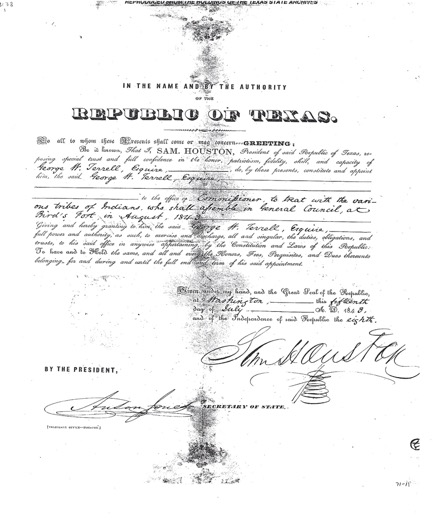
(Fig. 4)
Terrell reported back to Houston in mid-September explaining the results of his meeting stating;
I showed him (Rusk) the letter in the tavern – he admitted he wrote it – but said it was written under feelings excited by statements made to him from various quarters that you had refused commission (of the raid).
Terrell also stated that Col. Jennings had informed him that Rusk was in a “spree” when he wrote the letter and was heartily ashamed of it when he got sober. Terrell, who was of course a decidedly loyal to Houston also noted the greatness of Rusk.
I believe there has been a systematic attempt made to keep. Breach between Rusk and yourself. Terrell continued There are men in every country, who having neither talents not moral character to sustain themselves, endeavor to keep themselves afloat in the word by holding on the tails of some great men. Some such characters, he said probably Rusk has about him – inevitable enemies of Sam Houston, they manage to keep themselves from sinking into insignificance and contempt if they can keep up the split between him and Rusk. Terrell noted that when Rusk is drinking they can operate on his feelings and keep them excited but that when Rusk is sober those men were unable to do so. In explaining his impressions of Rusk, Terrell said to Houston Your favourite [sic] historian Xenophon, I think somewhere in his Institution of Cyrus, somewhere mentions one of his heroes had come to the conclusion that he had two souls a good one and a bad one – which predominated alternately. When the good one had ascendancy, his actions were all good and benevolent – but that when the evil principle prevailed his actions were vicious and detrimental. Terrell felt that if ever a man had two souls, it was their friend Rusk. Terrell felt that Rusk’ conduct had clearly been prompted by two opposing and governing principles just like that of the Persian Prince. Terrell ended by saying He [Rusk] was emphatically a good man and yet when the evil principle predominates within him- he is all wrong.[lxviii]
On 29 September, Terrell and Tarrant met with the Chiefs of the indigenous Nations of the that included; Roasting-Ear; Delaware Chiefs McCallah and James St. Louis; Chickasaw Chief Ish-te-u-kah-tubbyl, Waco Chiefs, Acah-quash and Che-tick-kaha; Tah-woc-cany Chief, Ke-chi-ka-roqua; Kechi Chief Kah-te-ah-tick, Red Bear; Caddo Chiefs Binchah and Had-dah-bah; Ana-dak-kah Chief Jose Maria; Ionie Chief Tow-a-ash; Beloxi Chief Hoyo Tubby and Cherokee Captain Chicken Trotter at Birds Fort (modern day Arlington Texas) and signed one of the few treaties ever ratified by the Republic of Texas, the Treaty of Birds Fort. The treaty comprised 24 articles. A summary of the articles follows.
Article I. The parties will “always live in peace” and “meet as friends and brothers. The existing state of war shall cease and never be renewed.”
Article II. The parties agree that it is the “duty of warriors to protect women and children” and that they will never make war on them; only on warriors.
Article III. The Indians will never “unite with the enemies of Texas” nor make any treaty with them which would require the Indians to take part against Texas.
Article IV. If Texas is at war with anyone, an Indian chief will counsel with the President of Texas.
Article V. Texas will appoint agents to hear the complaints of the Indians, to ensure justice between the Indians and the whites, and to communicate the orders and wishes of the President to the Indians.
Article VI. No one may “go among the Indians to trade” except by the authority of the government of Texas.
Article VII. No white man may sell or provide “ardent spirits or intoxicating liquors” to the Indians.
Article VIII. No one except a licensed trader may “purchase any property of an Indian” without the authority of the government of Texas.
Article IX. If any property of the Indians is found among the whites, or any property of the whites is found among the Indians, it shall be returned to its rightful owner.
Article X. No trader may furnish any “warlike stores” to the Indians without the permission of the President of Texas.
Article XI. No one may “pass the line of trading houses” (at the border of the Indians’ territory) without permission of the President and may not reside or remain in the Indians’ territory. These “trading houses” were later established at the junction of the Clear Fork and West Fort of the Trinity River in present-day Fort Worth. At this river junction, the U.S. War Department established Fort Worth in 1849 as the northernmost of a system of forts for protecting the American Frontier following the end of the Mexican-American War. The City of Fort Worth continues to be known as “where the West begins.”
Article XII. Any person who “molest[s] or attempt[s] to molest” the persons or property of the Indians while they remain peaceable, shall be punished for a felony.
Article XIII. Any white man who kills an Indian or commits an outrage against an Indian, shall be punished for a felony.
Article XIV. If an Indian kills a white person, he will be punished by death. If an Indian steal the property of a white man, he shall be punished by the tribe.
Article XV. No Indian may “cross the line” without authority and passport. No Indian may sell any property to a white man without authority.
Article XVI. If anyone “come[s] among the Indians without authority,” the Indians will seize him and deliver him to the Indian agent.
Article XVII. The parties will mutually exchange prisoners, and “not be friendly” with any people or nation who will take prisoners from Texas.
Article XVIII. The President of Texas may “send among the Indians” blacksmiths and other mechanics, and schoolmasters for the purpose of instructing the Indians in English and Christianity.
Article XIX. When the President sends people among the Indians as described in Article XVIII, the Indians will “extend to them kind treatment and protect them from harm.”
Article XX. The chiefs and headmen of the Indians will cause their “young men and warriors to behave themselves” in accordance with the treaty, and will punish them so as to keep the peace between “the white men and red brothers.”
Article XXI. Should any difficulty or cause for war arise between Texas and the Indians, the Indians will send their complaints to the President and hear his answer before commencing hostilities; and the government of Texas will do likewise.
Article XXII. After the Indians have shown that they will keep the treaty and not make war upon the whites, the President will authorize the traders to sell arms to the Indians, and to provide gifts to the Indians.
Article XXIII. The government of Texas will have the right of working all mines that have been discovered or will be discovered on the territory of the Indians.
Article XXIV. The President will make all arrangements and regulations with the Indians as he sees fit “for their peace and happiness.”[lxix]
In mid 1843, the general election of 1844 began to excite a general interest and Terrell advised Dr. Anson Jones, as early as July 1843, that his name was constantly mentioned in connection with the subject. Jones was elected president of Texas in September 1844 and took office on 9 December 1844. Jones, for his part made no campaign speeches, had not committed himself on the subject of annexation, which was an important subject in Texas by this time and did not mention the subject in his inaugural address. In October, Houston requested President elect Jones to advise Terrell that he had been appointed charge’ daffaires of the Republic to the courts of England, France and Spain. Upon his arrival to England, Terrell’s first priority would be to ascertain what the substance of correspondence was that had taken place between England and France on the subject of the difficulties with Mexico and the affaires of Texas in general. Secondly, he was to determine what both of those governments purposed to do in the matter of Mexico and refer the answers back to the Republic for its consideration and action. Thirdly, he was to enter into negotiations with France and England for the admission of products from Texas into their respective ports in more favorable terms than they currently were with present treaties. [lxx]
In November, James K. Polk’s won the election as president of the United States on a platform of “annexation of Texas” and President John Tyler’s proposal of annexation by joint resolution, Jones continued his silence but the Texas Congress declared for joining the Union. Before Jones received official notice of the joint resolution, Terrell induced Jones to delay action for ninety days. Jones promised to obtain from Mexico recognition of Texas independence and delayed calling the Texas Congress or a convention. Meanwhile, public sentiment for annexation and resentment against Jones mounted. He was burned in effigy, and threats were made to overthrow his government. Terrell, who was on his way to England via New Orleans met with Andrew Jackson Donelson, a nephew of Andrew Jackson, and proponent of annexation. After spending the evening with Donelson discussing the subject, Terrell dispatched a letter to Jones advising him of the political gossip by the Whigs, telling him that it was said that Sam Houston was a traitor – his cabinet no better – and as for President elect, he is bought in advance by British gold.[lxxi]
On December 14, Houston set a letter to A-Cah-Quash[lxxii], Chief of Wacoes to let him know that Terrell had told Houston of their meeting and that he would send many present at the council of Tahwocannay Creek in April
Brother,
I have heard of you in the prairie, I rejoice. My friends told me that you walked in the white path. Your words came to me by the lean captain (gen. Geo Whitfield Terrell). My heart is warm toward my friends. I will never forget that you were amongst the first to walk in the path between the red and white man. To let you know that you are not forgotten, and that I hold the friendly chief of the red man near my heart. I send you presents. Our nation is yet young, but will make us rich, and then I will send many presents to our red brothers. At the council of Tahwocannay Creek in April next, I will send you a new pipe that I have had made at a great distance from here. It will be a pipe of peace. You will smoke it with our friends at the council; and if I cannot be there to meet you, you must come to see me and we will smoke it at my own fire-side. I will look for the great chiefs of the different bands. If they come to see me they will not go away hungry.
I will expect you to go and stay with my friends till they go to the Comanches, and stay with them till the council.
I hope the great spirit will smile upon you and preserve you, and give many blessings to my red brothers.
Terrell was decidedly against annexation and very outspoken on the subject. He referred to it as this ignus fatuus, this will-o-wisp conjured up by the distempered brain of wild and reckless speculators. After interviews with the French Representative to Texas, Alphones de Saligny, Terrell advised Jones that France was ready to guarantee Texas independence provided Texas pledged herself to hold no further negotiations on the subject of annexation to the United States. Terrell believed that continued talks of annexation would fail and that Texas would plunge into the bogs and marshes of confusion and chaos, leaving Texas to work her way out, abandoned by all her friends in Europe and leave Texas to ruin. He strongly believed that Texas should take responsibility at once and give the guarantee Texas, free, independent, prosperous and happy, will ratify the act; and annexation, as it should, will slumber forever in the ‘tomb of the Capulets’. Once in England, Terrell wrote to Jones that if Texas was not blind to her own interest, she may within the next three years become one of the most prosperous nations on the face of the globe. He told Jones I pray Heaven in its mercy, and out rulers in their wisdom, to avert the evil of annexation, with all its concomitant dire calamities, insignificance, degradation, oblivion and annihilation, which must follow in its train. He feared that annexation was a ruinous policy and feared it would carry the sword of Damocles.[lxxiii]
Bent on Deeds of Glory
Even though the Texas Senate had not yet confirmed the appointment of Terrell, he arrived into England on January 12, 1845, after a voyage of more than forty days from New Orleans to Liverpool. From Paris, Terrell advised Jones about meeting with the Earl of Aberdeen, for the purpose of opening to him the subject of a reduction, by treaty, of the duties on articles of commerce of Texan growth and production. Terrell had scarcely taken his seat in the meeting before he discovered, from both the Earl’s looks and manner, that something was wrong. On his three previous meetings with the Earl, his demeanor had been cordial, his communication frank and free and Terrell felt he had been treated with a rather “marked attention.” Now the Earl was evidentially distant and reserved in his manner. Upon purposing some modifications in the existing treaty between the two countries, the Earl replied to Terrell that it would be awkward business to make any modifications or new treaties with Texas that had been “for some time” endeavoring to subvert the treaty that already existed since Texas and President Jones were decidedly in favor of annexation. [lxxiv]
Knowing that the secret was out, Terrell replied mildly, but firmly, that it was true that Texas had attempted a measure that if carried out, would void the existing treaty between the two nations. Terrell advised the Earl that Texas found her justification in the circumstances in which she was placed, because the Texas government, “both theoretically and practically,” was “emphatically” the government of the people; hence even her rulers could not, at all times, act upon their own convictions of national policy. As to the Earl’s information in regard to the sentiments and conduct of Jones, Terrell assured the Earl, from his own knowledge, that he was incorrect on both points. That Jones was decidedly in favor of annexation and that as Secretary of State he had labored faithfully to accomplish the measure, as had all the members of the then administration, except for himself. Terrell assured the Earl that, although this was the fact, the President of Texas was not doing anything at present, either openly or secretly, to favor annexation.
Upon explain to the Earl these facts, the Earl asked Terrell whether Houston or Jones had sent him on his present mission to which Terrell advised him that he was sent by both of them. The Earl remarked to his answer, it does not look like either of them was very anxious for annexation, or they would hardly have sent you here. For Great Britain’s part, they did not want to see annexation occur for the simple reason they still harbored resentment towards the United States and did not want to see her growth westward. For the United States part, annexation would give them the necessary latitude to provoke Mexico into war and gain land all the way to the Pacific Ocean.[lxxv]
On January 24, 1845, the Texas Senate rejected the nomination of Terrell for charge’ d’affaires. The rejection was due to Terrell’s very outspoken disdain on the subject of annexation. Although Terrell had not yet been informed of the Senate’s rejection, he had read about it in the newspapers of Paris shortly after his arrival there, and in a letter from Ashbel Smith. The rejection was of little consequence to Terrell, in fact, he really cared nothing about it, but to be rejected by the Senate, which he didn’t think he had a single enemy was very mortifying to his pride. Ashbel Smith, the previous charge’ d’affaires, informed Terrell that the Senate did not refuse his confirmation through want of confidence in his patriotism or talents, but rather because of his open hostility towards annexation. Terrell was directed to take leave of the Courts of Great Britain and France and return home. Terrell did not immediately leave; in fact, he still had business to conclude in France and then return to London before he could depart for Texas. While in France, Terrell’s treatment by the French Minister was less than congenial. Terrell, on March 15, 1845, addressed a note to Guizot advising him that he had waited in Paris for about a month and had waited a reasonable amount of time for his first interview, which had not taken place thus far.[lxxvi]
On March 17 Terrell met with Guizot, then was received by King Louis – Phillipe. In his letter to Smith about the meetings, he described Guizot as very shy on the subject of Texas affaires. Terrell felt that it was a very sore subject with the Minister. At 1 o’clock pm, Terrell would attend the Tuileries, and then was received by the King. He made a short address to King Phillipe:
I appear before your Majesty as the representative of the youthful Republic of Texas, and I assure you Sir, it is with feelings of no ordinary emotion that I, a plain republican, unused to the ceremony at the pageantry of Courts, find myself in this responsible capacity in presents of the sovereign of one of the mightiest nations of the earth.
This is embarrassment however, is much relieved by the character all accounts concur in giving, all your Majesty republican simplicity and urbanity of manners, in all the relations both of social and political life; nor is it unmingled with some degree of pride and self-gratification, that I represent a republic at the Court all og the King of the French – that magnanimous and chivalrous people, who have ever been foremost in the recognition of republican states and republican principles. It is a sentiment deeply cherished by the people of Texas, that France was the first European power to take the infant Republic by the hand, while her steps were yet tottering and her confidence still faltered and welcome her into the great family of nations.
I am instructed by my Govt to make known to that of your Majesty, the high appreciation placed by it upon the uniform friendship manifested by France towards Texas, from the earliest dawn of her national existence – and it is made to my duty, as it shall be my pleasure, to continue to cultivate that good intelligence and those friendly relations, which heretofor so happily subsisted – and if possible even to strengthen and extend the bonds of friendship and the intercourse between the two Countries.
I am also instructed to express to your Majesty the sense of obligation felt by the Govt and the people of Texas, for the generous efforts made by your Govt to adjust the difficulties existing between Texas and her mother republic – and I trust that I shall so conduct myself, as the representative of my country, asked to convince your Majesty that we merit a continuance of those good offices in our behalf; indeed Sir, I fondly cherish the hope that the fact of having been instrumental in giving peace and permanent independence to a young and rising Republic will, in future times, constitute the brightest page in the history of your Majesty’s illustrious reign.
There is yet another part of my duty which I assure you Sir, I perform with sincere pleasure – that of expressing the wishes of my Govt for your Majesty’s health, happiness and long continued and prosperous reign – and also for the happiness and prosperity of your whole Royal family.
After Terrell’s address to the King, entered into an in-depth conversation with regard to the “condition and affaires of Texas.” King Phillipe made it clear to Terrell that he wished for Texas to remain an independent nation. His reasons were primarily due to agriculture and commercial interest. Finally, he concluded by telling Terrell that he could not see how Texas would benefit in any particular by annexation. He then addressed Terrell:
I am pleased to hear these sentiments from your Govt. France is proud of having been the first nation to recognize the independence of the U. States – and also that she was the first of the Nations of your rep that recognized the independence of Texas. You will please make known to your Govt. That France has ever felt, and continues to feel, a deep interest in the welfare and prosperity of your young and promising Republic. You have shown ourselves worthy of independence, and it is the wish of the French Govt. to see you maintain it and remain a separate and independent nation. We have exerted all our moral energies, and will continue to do so, to procure the recognition of your independence by Mexico; and you may I sure your Govt. that no exertion – consistent with our obligations to other Govts – shall be wanting on the part of France, to bring about a result so desirable; and which it is my opinion is for the interest of the U States as well as of Texas.
I have always been a warm friend of the U States – and so I am of Texas – for I look upon you all as the same people, but I believe it is for the interest of both nations that you should remain separate.
The king, in a conversational tone, repeated that he felt great solicitude for the prosperity of Texas and would continue to do everything within his power to advance her interest.[lxxvii]
Due to his illness, and the Parisian weather, Terrell needed to depart for London and thence Texas as soon as possible. Terrell departed for Texas via London in which he had one final meeting with Lord Clarendon who had questioned Texas, Texans, and her independence in the first place. Terrell explained to his Lordship that the statements he made did an injustice to the people of Texas and that he felt called upon to vindicate them from the imputation so unjust and injurious as to place his Lordship in possession of the facts. Terrell explained to Clarendon that the Anglo Americans were invited into Texas by the Mexican government and they had settled under a Constitution and laws guaranteeing them the rights and privileges that constituted an inducement to leave the land of their birth and seek a home among strangers. He went on to explain that the Mexican government made those inducements and granted those immunities to the Americans to place a barrier between the Mexican population and the various Indian tribes that resided on their frontier and made frequent interruptions into their territories. In this the Mexican government succeeded. As long as the American population who came to Texas, and became Mexican citizens, as bona fide as though they were born on the soil, were permitted to enjoy the rights and immunities guaranteed to them by the Constitution, and laws under which they had settled in the country, they remained quiet and obedient to the laws. But when the constitution under which the Americans had been invited into Texas was subverted by violence, and a military despotism erected upon the ruins of the Federal Union, the people of Texas met in solemn convention and declared their determination not to submit to this lawless usurpation. Not wishing to sever the federal compact, the Texans also invited the other Mexican states to unite with them. they did not make any declaration or take up arms until Santa Anna had invaded the country at the head of a formidable army threatening the extermination of the Anglo Americans within the limits of Texas, a threat that he carried out with precision that the events of revolution in 1836 grew, the results of which is known worldwide. The fortune of war also placed the author of all their troubles and calamities, Santa Anna himself, in the possession of the Texans and instead of sacrificing him to the spirit of revenge, as was their right to do, the Texans instead set him free along with his countrymen which numbered more than the whole of the Texas army. It should be noted that Texas was not the only Mexican state to declare their independence or have a rebellion with the Centralist government of Mexico. The other Mexican States to declare independence included Zacatecas, the separation of Tabasco, the Independence of Coahuila, Nuevo León and Tamaulipas that formed the Republic of the Rio Grande and finally the Independence of the State of Yucatán.
On 11 May 1835 Zacatecas had a rebellion and took up arms against the Centralist regime of Santa Anna.
The Federalist Revolution was a civil war that developed in the state of Tabasco , Mexico from 1839 to 1840 , having as its origin to fight against the establishment of the Centralist Republic of Mexico in Mexico.
On 17 January 1840 a meeting was held at the Oreveña Ranch near Laredo. A group of notables from the states of Coahuila, Nuevo León, and Tamaulipas advocated for a rebellion seeking secession from Mexico and formation of their own federal republic with Laredo as the capital. However, those states’ own congresses and governments never took any action to support the insurgents, and requested the help of the Central government in Mexico City to aid the local state armies. Despite the lack of support from the state governments, the Republic of the Rio Grande was formed. Shortly after the formation of the Republic of the Rio Grande, word arrived that General Arista was in the Rio Grande valley. Texan Samuel Jordan urged Canales to retreat to Texas to recruit more Texans but Canales refused. Consequently, Samuel Jordan and 60 of his men left General Canales’ army. While Canales and the army decided to fight, President Cardenas and the new government fled to Victoria, Texas.
Canales and his army met Arista outside the town of Santa Rita de Morelos. Needing provisions, Antonio Zapata and 30 men rode into town where Arista’s men soon surrounded them. Outnumbered by 1,800 men, Zapata surrendered. General Arista offered to pardon Antonio Zapata under the condition that he swore allegiance to Mexico, but he refused. On 29 March 1840, Antonio Zapata was executed and his head placed on a spike in the town of Guerrero as a reminder to his wife, children, and federalists. While Zapata was being held prisoner, General Canales engaged Arista at San Fernando, losing 250 of his four hundred men in the process. After this defeat, Antonio Canales had no other option except to flee to Texas. In Texas, Canales rebuilt his new army at San Patricio under Colonel Samuel Jordan. The new army consisted of 300 Mexicans, 80 Cane Indians, and 410 Texans. With the new army, Canales marched out of Texas and was able to recapture the towns of Laredo, Guerrero, Mier, and Camargo.
Soon after, Canales ordered 350 men, under the command of Samuel Jordan and Canales’ brother-in-law Juan Molano, to steal horses for future operations. After Jordan and Molano sacked the city of Ciudad Victoria and installed a new state government, they marched to Saltillo where the Mexican General Montoya was residing. Unbeknownst to Jordan, Juan Molano had secretly switched sides and joined the centralist forces.
On 25 October 1840, the Mexican army under Montoya faced the army of the Republic of the Rio Grande under the command of Colonel Lopez (who had secretly switched allegiance to General Montoya as well). Colonel Lopez ordered Jordan and his men to move into a mountain gorge. Upon realizing the trap, Jordan, his men, and the remaining loyal vaqueros to the Rio Grande Republic turned around and took refuge in a hacienda. The Mexican army attacked the hacienda in full force but was unable to capture the Texans before they retreated. The Mexican army lost four hundred men[dubious – discuss] attacking the hacienda while the Texans only lost five.
After the first rebellion in 1823 in which the Yucatan declared independence, the second Republic of Yucatán began in 1841, with its declaration of independence from the Centralist Republic of Mexico. It remained independent for seven years, after which it rejoined the United Mexican States. The area of the former republic includes the modern Mexican states of Yucatán, Campeche and Quintana Roo. The Naval Battle of Campeche took place on April 30, 1843, and May 16, 1843. The battle featured the most advanced warships of its day, including the Mexican steamer Guadalupe and the equally formidable Montezuma which engaged a squadron of vessels from the Republic of Yucatan and the Republic of Texas. The latter force consisted of the Texas Navy flagship sloop-of-war Austin, commanded by Commodore Edwin Ward Moore, the brig Wharton, and several schooners and five gunboats from the Republic of Yucatán, commanded by former Texas Navy Captain James D. Boylan. Texas had declared its independence in 1836, but by 1843, Mexico had refused to recognize it. n Yucatán, a similar rebellion had begun and was fought off-and-on from 1836 to 1846.
Once Terrell arrived at the Port of New York, he sent odd a quick note to Jones:
I snatched a moment merely to inform you I am thus far on my way home, after tedious voyage of forty-three days from Liverpool.
I learn, since my arrival here, that you have had stirring times in Texas. Poor Texas! Thy infatuated sons will yet have cause to weep over thy untoward destiny, when they shall behold the bright little star so lately culminating to the zenith of the political firmament sinking into the darkness of an endless night! [lxxviii]
Deeds of Noble Daring
Terrell arrived back into the port of Galveston on October 2, 1845. Upon his return, he made a speech, determined to let the country know what he thought about annexation. Terrell was the most outspoken Texan leader on the subject of annexation. A gathering was held of people of distinguish character and dignitaries, including President Anson Jones in Galveston that evening. Journalist, Diplomat and writer, William Kennedy was present for the entertainment. Kennedy sent a copy of the of the paper containing the speech, published in the Galveston Advertiser to the Earl of Aberdeen highlighted and remarking two of the passages in Terrell’s speech. First, his thoughts about the United States “expansionism” and possible consequences and disruptions in the Federal Union by Texas’ annexation and second about the “alleged design of Great Britain” to effect the abolition of slavery within Texas if it remained a Republic unto itself.
Terrell wanted to avail himself of the opportunity to give the citizens of Texas his opinions on the great question which engrossed the attention of the people, from one end of the Republic to the other. He went on to say:
For this I have two reasons, one is that, so far as I have learned, no man has been found to raise his voice against policy or the consequences of the measure – and I unwilling that it shall be said in after times, when the people shall be awakened from the delirium into which they are now thrown, to the consequences which I believe must inevitably result from this fatal measure, that no man was found born his countrymen of the dangers which awaited then precipitated action on this subject. This is therefore an opportunity which I wished for, to ask why recorded remonstrance against the consummation of the measure which I believe to be fraught with consequences so fatal to the vital interest of my country. My other reason is that, inasmuch is there is a vote to be given by the people directly upon this question, there is yet time to avert the evil, if they will stop and reflect before they make the fatal deed.
In bringing this matter before the people of Texas, Terrell would only give those gathered and the journalist his opinion on the question involving the interest and the very existence of the nation; and the reason for those opinions in the plainest and shortest manner.
When nations move they always have some great object to accomplish it by. What object has Texas to accomplish by annexation? – what her prospects – what her hopes? In making so important a change in her political condition, she of course expects to derive some great benefit from the change. He asked.
I would say to the advocates of annexation “come now and let us reason together” on this great question.
Then what are the reasons which the advocates of this measure urge in favor of its adoption? – The first and greatest argument is the greatness, the grandeur, of the American Union. “the flag of this mighty nation will waive over us and we will be a portion of the great Federal Union.” There is certainly some allurement in this argument. There is something attractive in the idea of belonging to one of the first powers of the earth.
He went on asking whether they had reflected on what portion of this mighty confederacy Texas would constitute when she was admitted into it as a state. Having surrendered her nationality, she will be shorn of every attribute of sovereignty. He felt that talk of the sovereignty of one of the states of the American Union was ridiculous nonsense and she would never be more than a “tenth rate” state in that confederacy. He would then ask of his annexation brethren whether they would not be more respectable even as an inferior Republic, than as one of the inferior state of the great American Union? Then going to great detail about the state of things in the United states, Terrell said Look at the state of things some twelve years ago, when the Union was brought to the very brink of dissolution by the nullification of South Carolina. Is it all improbable let the same things may occur again?
Terrell then started on the second argument used by the friends of annexation which was it would ensure Texas peace or war and if that fails it will give us protection.
As far as the question of peace or war is concerned, Terrell started off, the very way to prolong the latter, it must be obvious every reflecting mind, is to adopt annexation.
The argument of Gen. Houston in his letter to Gen. Jackson was that annexation would give us peace, according to Terrell. However, Terrell felt that instead of its bringing Texas peace, it would prolong the war. A thought that Terrell was correct about. Then there was the question of slavery in Texas, but Great Britain is determined to free all the slaves in Texas. This is another argument much harped upon by the writers of the United States. Terrell said. We must become a part of this great Union to prevent our slaves from being freed by the intrigues of the British Cabinet. A wilder chimara was never engendered in the imagination of the most intellect. Terrell having spoken to the Earl of Aberdeen at length in the subject knew full well that Great Britain would not require Texas to abolish slavery. This avowal I forwarded to our State Department in February last, and requested its publication for the information of our people – but the Secretary thought it most prudent not to publish it at the time. Our institution of slavery therefore is safe Terrell explained. He went on to ask if slavery would be abolished as a state in the Union, We are at present free from all excitement on the subject – can our brethren of the U. States say as much? Look to the ballot box in their Northern States and examined the increase of their appellation boat in the last four years. Look, also, to what has happened amongst them during only the last year – when it comes to the fact that a religious denomination, bound together in bonds as strong as those which bound the great Methodist Church, is burst asunder and torn to pieces by this question, it is time for the political institutions of the country to be on the lookout. Terrell ended his very long speech by saying;
For the sentiments for which I have now uttered I shall of course be prescribed, both here and the U. States. Be it so. I am so deeply impressed with the conviction of their correctness that I am perfectly willing to abide to the result and stand or fall with them. Even if I should be doomed to suffer potential martyrdom.[lxxix]
[Authors note – I have included the entirety of Terrell’s speech as the only found copy of this Galveston Advertiser edition that could be found resides in the National British Archives and for Texas history felt that the entirety of the speech should be recorded here with-in]
For me to attempt to give utterance to the feelings with which the sentiment just announced as inspired by bosom, when be vain and fruitless. The proud designation, of a honest man – faithful public functionary, to be thus welcomed by those who have known me long – amongst whom I have lived and with whom I have associated for the last five years, is a distinction upon which the most elevated might well pride himself: – but for an individual humble as myself to be thus distinguished, and especially under the peculiar circumstances of my situation, is a source of the highest gratification. We’re laboring under any chagrin or mortification, from the treatment which I have received from one branch of our government the hearty welcome with which I have been greeted, not only here, but in every part of the country, would have been ample compensation for the injuries, either real or supposed. The newspapers too have you done me most ample justice – therefore I avail myself of the present occasion to tender the corps Editorial (of which by the way I am proud to acknowledge myself to have been a member) my most respectful acknowledgments. I am too great and advocate for Constitutional liberty to complain of its exercise by others – although I may feel it operation in my own person. The Senate, in rejecting my nomination as Minister to England and France, only exercise the functions invested in them by the Constitution of the Republic; and knowing my sentiments upon the great question of annexation as they did – it was natural that they should not wish a man entertaining those sentiments to represent the nation at those courts; they therefore did no more than they had a right to do and I have no right (and certainly am not disposed) to complain. There is one thing, however, which I am disposed to do viz.
To avail myself of the opportunity now afforded me to give my fellow citizens of Texas my opinions on the great question which now engrosses the attention of the people, from one end of the Republic to the other.
For this I have two reasons, one is that, so far as I have learned, no man has been found to raise his voice against policy or the consequences of the measure – and I unwilling that it shall be said in after times, when the people shall be awakened from the delirium into which they are now thrown, to the consequences which I believe must inevitably result from this fatal measure, that no man was found born his countrymen of the dangers which awaited then precipitated action on this subject. This is therefore an opportunity which I wished for, to ask why recorded remonstrance against the consummation of the measure which I believe to be fraught with consequences so fatal to the vital interest of my country. My other reason is that, inasmuch is there is a vote to be given by the people directly upon this question, there is yet time to avert the evil, if they will stop and reflect before they make the fatal deed.
In bringing this matter before the people of Texas I sure a lot of rhetorical flourishes or practical display. All you know that the condition of my health is such asked to preclude the propriety of any intellectual effort would to Heaven it were otherwise, for the subject is enough to inspire any man who loves his country with the spirit of true eloquence – it is sufficient to add wings to the imagination of the dullest intellect that has once spark of the fire of patriotism about it. I shall only give you my opinion on this question involving the interest and the very existence of the nation; and the reason for those opinions in the plainest and shortest manner. All we all acquiesce in the republican maxim that majorities have a right to rule, it is conceded by all republicans that minorities have rights which are as sacred as those of the majority. All though the opponents of annexation are in a minority, yet they have as great an interest in the measure as its friends have – consequently they have an equal right to the expression of their opinions. This is a measure of national concern, involving alike the interest of the whole community. When nations move they always have some great object to accomplish it by. What object has Texas to accomplish by annexation? – what her prospects – what her hopes? In making so important a change in her political condition, she of course expects to derive some great benefit from the change. Let us then equire (sic) (as rational man it becomes us to do so) what these unexpected benefits are – and whether there may not be some danger that these great blessings may be over balanced by evil that may result from the measure. Let us then in the spirit of man engage in the search of truth, and in the temper of friend – by investigation, examine into the reasons both for and against annexation. The Deity himself once condescended to invite the rebellious (sic) creature man to come and reason with him – in the language, therefore of Holy Writ, I would say to the advocates of annexation “come now and let us reason together” on this great question.
Then what are the reasons which the advocates of this measure urge in favor of its adoption? – The first and greatest argument is the greatness, the grandeur, of the American Union. “the flag of this mighty nation will waive over us and we will be a portion of the great Federal Union.” There is certainly some allurement in this argument. There is something attractive in the idea of belonging to one of the first powers of the earth. But I would ask my fellow citizens whether they have reflected what portion of this mighty confederacy Texas will constitute when she is admitted into it as a state. Having surrendered her nationality, she will be shorn of every attribute of sovereignty – for to talk of the sovereignty of one of the states of the American Union is ridiculous nonsense – and she never will be more than a tenth rate state in this confederacy. I would then ask my annexation brethren whether we would not be more respectable even as an inferior Republic, than as one of the inferior state of the great American Union? – Whether the lone star state would not shine more brightly in the galaxy of nations through its own unaided light, than by the dim light that shall be faintly reflected upon it from the superior brilliancy of this great constellation? Whether we would command more respect as an independent republic of respectable dimensions, population and character, or the intangible fragment of almighty confederacy? What is there to hinder Texas from becoming amongst the most respectable nations of the earth? Has she not all the elements of national greatness within her own limits? With an extent territory larger than all of France – and more than double the size of Great Britain – the finest climate to be found on the habitable globe – the most beautiful this the son of Heaven ever shove upon – the most prolific soil that ever yielded its fruit to the culture of man – producing the great staples sugar, cotton and grain in unexample to abundance – with a sea coast stretching the whole extent of our territory from East to West, and good navigable rivers running convenient distances through the whole interior – every variety of minerals in inexhaustible abundance embedded in the earth in many parts of the country and Subines (sic) and Salt Lake’s sufficient to lurnish (sic) the American continents with this valuable commodity.
With such a country as this possessing all the natural advantages of which any country on the face of the globe can boast, inhabited by racist people superior intelligence and in enterprise to any other the world ever saw – eight people who have never been known to recede when once they had planted their foot upon a new soil, what was there to prevent Texas, in a very short time, from becoming one of the foremost nations of the world? Save the blighting influence of Annexation, nothing less than first Jehovah himself could have prevented it. We are already making more rapid advances than any other nation ever did it the same age. The history of the civilized does not furnish a parallel to the advancement Texas as made in agriculture, in legislation, in respectability and commercial importance, considering her age and numbers. We had already formed treaties of amity, commerce and navigation with most of the great powers of the earth – we have wholesome laws of our own making and ours have become strictly a law abiding people. Ours is the most simple form Republican government, which has hitherto certainly work very well. Political economist all agreed that a greater simplicity in the machinery of government the greater the guaranty (sic) that it will work well. In this particular we have, in my opinion, a very great advantage over our sister Republic: it is even conceded by some of her ablest statesman that we have improved upon their frame of Government. So far then, as national pride should way, I think it’s clear that we shall make nothing, but will lose a great deal by surrendering our nationality and becoming a tenth rate state in the Federal Union. Ours is at present a cheap and economical government – supported by an indirect taxation unfelt by the great body of the people: whereas when we are formed into a state government the whole expense of that government will have necessarily to be defrayed by direct taxation: there will be no custom-houses then through which the revenues to support the government will be collected, unfelt by the people. I have no question of the fact that within two years from this time, we would have been able to reduce our tariff on an average ad valorem of duties ranging from twelve to fifteen percent, from which would have been collected revenue sufficient to have to defrayed the whole expense of the Republic – and, if we chose, we would have abolished in direct taxation entirely. Our people, particularly our brethren of the East, who were so much disposed to complain of our very light tariff, will find it a very different thing when they get into the Union and have to pay tariffs duties to about three times the amount they have heretofor paid upon all foreign importations, and have their taxes increased in a tenfold ratio over for what they have been.
Again I would ask those of my countrymen who regard to greatness of the American Union is of paramount importances (sic) to all other previleges (sic) imroutines (sic) in this country inasmuch that they are willing to surrender all these for the honor of having the flag of that mighty country to waive over them, whether they have reflected that, by the consummation of the very measure which is to make them a portion of this great Union, they may be endangering the existence of that Union itself? It is the opinion of many sober reflecting that the American Union by spreading itself over to great an extent of territory is showing the seeds of its own dissolution. And I confess that my opinion is if this confederacy can find to extend itself thus, it will furnish ground of the most sober apprehension for the safety of the United States, many of the Southern politicians of the United States are already talking of the southern confederacy. When Texas Shelby added to Union, these men will conclude that the south is now strong enough, and has territory enough to form a great nation, and it is time to break with the North, for whose benefit they declare the whole south to have been long under contribution, by the legislature of the United States Congress – and under which state of things they have four years been exceedingly impatient. Look at the state of things some twelve years ago, when the Union was brought to the very brink of dissolution by the nullification of South Carolina. Is it all improbable let the same things may occur again? In such an extent of territory the United States now possesses and seems grasping at the interest of different and distant sections of the country Will be so varied and diversified that conflict of opinions and collision of sentiment, if not collisions of states, must necessarily arise – legislation which will operate oppressively upon one section and to the advantage of another is the inevitable consiquence (sic) – thence conflict must result.
If you wish to know what it will do any given situation, you have only to ascertain what is their interest, anything you may predict their conduct almost with unerring certainty. – to hold men in the community you must have them bound together by some ligament stronger than legal enactments, or the abstract principle of patriotism. On some occasions, in times of high excitement, the conduct of men, and even communities, will baffle all calculation – in such times patriotism is an incitement that will urge men on to acts of chivalry, two deeds of noble daring – may well induce many to lay down their lives for their country: but, in sober business transactions of common life, her voice is stifled at hushed by the loud and potent calls of interest and selfishness. Judging then from this predominant principle of human action, and which is found in the philosophy of human nature – whenever the interest of the different sections of the Union become so diversified as directly conflict – there must follow a conflict of public sentiment, perhaps legislation – strifes (sic), animosities, agitation Will ensue that will shake the government to its center, and probably to its dissolution. This would be the patriot Republican throughout the world, a source of the most melancholy reflections. For myself I can imagine no greater calamity that could default the human race, than to see this last effort mankind at self-government, at wish I had been accustomed to look upon as the most stupendous fabric of human wisdom that has ever been reared – to see this mighty fabric tumble and ruins – and the individual members of that splendid constellation which compose the proud banner of this glorious Union, which now makes the bosom of every American patriot swell with emotions of pride and exultation wherever he sees it float, – sinking, star after star, into the darkness of endless night.
The next great argument used by the friends of annexation is that it will ensure us peace or war – and, if that fails it will give us protection. As far as the question of peace or war is concerned, the very way to prolong the latter, it must be obvious every reflecting mind, is to adopt annexation. The great argument of General Houston in his celebrated letter to Gen. Jackson was that annexation would give us peace – the whole scope of his reasoning throughout the letter went to prove that all advantages of the bargain was in favor of the United States and against Texas – but it would bring us peace, and this was to outweigh all the evils that would result to Texas. Now, if all the other arguments are against the policy of the measure – and this, the only one in its favor, turns out to be fallacious, why then it follows that the authority, it’s against annexation. Instead of its bringing us peace, I have said from the beginning, and still say, it will prolong the war.
But then, if it does bring with peace, it will give us protection, and that is the same thing. Protection from what? Why from Mexican invasions to be sure! – Is there a manage the Republic of Texas that will acknowledge himself afraid of Mexican invasion? If there is, I have never seen him. Every man within these walls knows that all Texans has asked of Mexico for the last five years, is that she would invade us with her best force, that we might decide the controversy once upon the field of battle. Look at the fax of the cause. We achieved our independence when we had perhaps one fourth the strength and resources we have now. Mexico was much stronger than at present. We are increasing strength and resources every day – Mexico from faction and intestine divisions is growing weaker is fastest we are growing stronger. And yet in the state of things there are men found in Texas who would knowledge they want protection! For my own part, I have ever believed, at half often declared, that Texas was the degrading herself for interference of foreign powers in this matter at all. But say the advocates of annexation “we have so much harrassed (sic) by the predatory incursions of the small bands of Mexican marauders, – the country can never prosper under this any longer.” Now there are three good arguments against this position, either of which will completely overturn it. In the first place the country is in a more prosperous condition than ever it has been since its settlement; it’s progressive improvement for the last three years has been much greater, and it is now in a better condition than any one of the southern States of the Union. In the second place we have not been annoyed I want of these marauding incursions for more than three years – and there was no danger of there being renewed, for the reason that the United States, Great Britain and France had all protested to the Mexican government against the continuance of that mode of warfare – as violating the laws of nations, and all the rules of civilized warfare; – and therefore she must put a stop to it. And lastly, if this had not been the case, I say the United States would never have shielded our Western front cure completely from those predatory incursions. – how was she to accomplish it? She could not do it without directing a chain of forts along the whole extent of our Western in North Western frontier, so near one to another that the sentinels would have been within hailing distance of each other. Unless they did this those stealthy, slippery Mexican Rancheros would steal by them. Is it to be expected that the United States can replace better troops there than we have had – or both better adapted to that peculiar kind of service? Will their officers be more vigilant or understand the nature of that service, or the character in the habits of any better then that true son of chivalry jack hayes, who, like Menalippus of old –“Bent on deed’s of glory, but a votary at the shrine of modesty. he scorns the arrogant vaunt As base, but bids brave actions speak his worth.”And his gallant companions Howard, McCullaugh, Chevallie and Ogden and others? – A – d yes the Wiley enemy has twice made his way into our western settlements before he was discovered. But whoever heard this restless inpatients of our people until the prospect of annexation was held out to them? Seven years had elapsed since the revolution – during all of which time we had been harrassed (sic) and annoyed by the enemy – we moreover, laboured (sic) under many other disadvantages, embarrassment and privations, which we submitted to like been determined to triumph – no man then heard these complaints. But when all these harassments actually ceased – peace and plenty pervaded the land – no heavy burthens to oppress- no pecuniary embarrassments to annoy us – the country progressing in prosperity and with unexampled rapidity- in an evil hour for Texas, the United States opened the door for annexation, and suddenly our people discovered that they were so much annoyed by Mexico that they could not possibly stand it any longer. Great argument with our rabid annexationist( for there are such amongst us) is that we are getting back to our fatherland – to live amongst our brethren – and with them it is treason in any man to raise his voice against this measure. This is touching the tenderest (sic) cord of our human heart to vibrate in unison with a proposition. But, before we yield every thing to the sway of ___ softer feelings, would we not be well to look a little into those our breath rate and kindred, before we yield up all, and rush blind – fold into their power, for the sake of getting back to our father-land? Suppose one of you when I first grown to mom’s estate, left the paternal roof and wandered to a distant country, and there resided until you had acquired property and became respectable – By and by, you concluded you will return to the paternal mansion and live with your brethren – but the estate has fallen into the hands of an elder brother, who positively refuses you admittance, you returning in a year or two you make the attempt again, and our again repulsed in the most unceremonious manner. But eventually learning that you were exceedingly anxious your brother says to you if you will give me all you have in the world – you may come and live in one of my out houses – but mind you I am to have everything you possess in the world, and if you owe any debts I will not pay them, I hear you have a piece of wild land that is of no value – if I cannot sell that to any advantage you make take it to pay your debts with, but I reserve the right to sell it if I can. Is there a single man in this assembly – is there a man in the Republic of Texas who which so far degrade himself as to submit to such humiliating terms, and live with his brother? – now this is the case directly analogous to the expectations offered us by the United States. And they are just such terms as I have all the time said to the people they would have imposed upon them by the United States. I pretended not to have any gift of prophecy, or superior foresight – but, judging up the character of the men from what it has ever been, I certainly did, long since predict to the people of Texas the character of the bargain they would get from the United States. This is no after thought of mine – for my opinion was recorded in one of your public journals Long before the passage of the resolution of the American Congress, that Texas never would get in the United States such terms I she could accept without humiliation and degradation. – I think it can proved to the satisfaction of everyone unprejudiced mind, that the United States, throughout this whole transaction, have evinced a disposition literally to rob Texas of everything she had on earth, and give her nothing in return. This is a strong assertion but I am prepared to make it good. That treaty of annexation concluded in 1844, although better than the Joint resolutions of Congress was of such a character that our special Minister at Washington (one of the purest men that ornaments this or any other country) thought it necessary to fill a good portion of along letter with the apologies for the harshness of the terms he had submitted to: – and yet, harshest those terms were, the Joint resolutions under which we are now to go into the Union are much more oppressive. In the treaty they agreed to pay our debt $10,000,000 for our public lands – which are worth five times the amount – but, in the resolutions, they do not want the lands, and “in no event” will they pay one dollar of the debts of Texas. Why this change in their policy? Mr. Benton in the meantime had said the public debt of Texas amounted to it at least 22,000,000 and our public domain was worthless; that all that was of any value was already appropriated &e. Hence, in the resolutions, this feature of the treaty was omitted – it was “repudiated,” and in its stead the clause that “in no event shall the debts and liabilities of Texas become chargeable to the United States,” was inserted. Those gave to the President of the United States presenting them to Texans the basis of Annexation, or of appointing commissioners who, in conjunction with commissioners on the part of Texas, should agree upon the terms on which Texas should be admitted into the Union. Now I say, if even the executive of the United States had been disposed to exercise any liberality towards Texas, he would have chosen to set upon the alternative resolutions; he would have given us a voice in the matter, and thus have given us terms at least somewhat more equitable. It would have required but a few months more to have consummated the measure. But no, selected these unjust and oppressive resolutions as a basis of his actions. Why was this done? What’s Mr. Tyler afraid would get a portion of the credit of this great measure that you must hurry it off in this precipitate manner? It is said by his friends Becky was afraid to endanger the success of measure by submitting to another Congress, as a alternative resolution contemplates. Now this is either not true, or our people are resting upon a broken reed. Ether the government was insincere then, or that they were not since year of the assurances offered through their Minister to our government, that the next Congress would modify those terms (four they did not attempt to justify them) and make them better for Texas. No my friends, the true reason was that the United States had been led to believe that Texas would accept any terms they choose to impose – and the result proves that they were right in that opinion. I must do the present Executive, Mr. Polk, the justice to say that he manifest the most liberal disposition towards Texas. He said to me a few weeks since “Texas has thrown herself upon the ___ of the United States, and we will not disappoint her ___ justice.” I know Mr. Polk to be an honest, correct and ___ man, and, as far as depends upon himself, or his Cabinet. I have no doubt they will do all they can to repair the entry done Texas – but the experience of the last four years has taught us that the Executive is not the government at all times. You are all well acquainted with the terms contained in these resolutions, therefore it is useless to repeat them. Are they such as any people possessing any independence or pride, ever would accede to. While I was in London, a letter was received there by a gentleman from his friend in this country – and in reference to these it contained this remark – “if you expect the people of this country to manifest any national pride on this subject, you will be altogether disappointed.” I repelled this assertion at that time, as a slander upon the character of my countrymen – but to my great mortification I found before I reached home that the writer had judged of them more correctly then I had. But to the terms themselves – I assert boldly that a spirit of injustice more glaring – of oppression or grinding – rapacity more grasping was never manifested by one nation towards another, at the same time professing friendship for it. Do they not literally require Texas to strip herself naked and then deliver herself bound hand and foot into the power of the United States? This is the true spirit of these resolutions. They take everything we have upon earth, except the public domain, and that they reserve to themselves the right to give away to Mexico. They require us to cede to them “all public edifices, fortifications, barracks, ports and harbors, navy yards, docks, magazines, arms, armaments, and all other property an means pertaining to the public defense” – they will have all this property, which cost Texas millions of dollars, and refused pay even the little pittance of a balance 0f $250,000 which Texas yet owes upon the purchase of the navy – and they will get very near leave this amount annually out of Custom Houses. I said they reserved the right to giveaway our public lands to Mexico – and this right was reserved for that very purpose. They reserve to themselves the “right to adjust all questions growing out of boundary with other governments.” I said that they intended to give it to Mexico; here is the evidence of it. Mr. Calhoun, while Secretary of State, Rights to Mr. Shannon the American Minister in Mexico – “say to the Mexican government at should annexation take place, the United States will be prepared to adjust all questions growing out of it, including that of boundary upon terms of the most liberal to Mexico.” – there then is the solemn pledge of the government of the united states to settle this question of boundary upon terms the most liberal to Mexico. From this pledge the government of Mr. Polk cannot recede (if he could, I believe he would) then, in an amicable adjustment of the question, what becomes of our public domain – Mexico will say, and that certainly with great plausibility, if not justice – “you must confine taxes within her original limits. The Nueces (or as some say the Aransas) was always the boundary of Texas until she extended her limits by mere legislative enforcement over New Mexico, and the country from the Nueces to the Rio Grande, but she has never occupied it” – To such an argument what can the United States reply? – here is her solemn pledge to settle the question of boundary upon terms most liberal to Mexico. Be assured, my friends, in any amicable adjustments okay this question – the greater portion, if not the whole of that country is gone. If we should have war with Mexico, we will save the whole of it. The land acquiring propensities of the North Americans – their spirit of acquisitiveness, is so great that I have no doubt they will sustain our claim to the whole territory. But the American letter writers say United states must take Texas under their protection, or she becomes a British colony. This is the spirit and the ___ of every letter that I have seen written by a citizen of the United States upon the subject. Not that they care any thing in the world about us – as to ourselves, they do not deem us worthy one moment’s consideration – all their letters and speeches are filled with arguments showing the advantages that will result to the United States from annexation, but never one showing any advantage that is to accrue to Texas – they do not actually deem us worthy to be taken into calculation at all – it is all the position of Texas – the advantage the territory would be to the United States, and the injury to them if we fall into the hands of Great Britain – one or the other of which we are compelled to do. As to our remaining an independent Republic, that is altogether out of the question. Now, I would ask my fellow citizens if this is not a direct insult to the understanding of every independent man in Texas? We have sustained ourselves for ten years amid troubles and difficulties, and embarrassment almost unexampled – and now, when we have really weathered the storm, have actually gotten into smooth water – when we have experienced a great improvement in the moral and social condition of our country than any other can boast in the same length of time, when, in those parts were five years ago violence, outrage and crime prevailed in the land, help peace, order, and obedience to the laws have taken their place; yet we must be taken under the protecting wing of the American Eagle or we inevitably fall into the jaws of the British Lion! And yet these are the people entertaining and expressing this opinion of us, that are infatuated brethren are ___ ___ ? – but they’re protecting us from the British Lion reminds me of the fable of the wolf that persuaded the lamb to take shelter in his care from the danger of the beast that prowled the forest, and, of course devoured it himself, as soon as he felt the approach of hunger.
I wish to put one question to the serious and sober consideration of my countrymen – and, if possible, I wish them to divest themselves of prejudiced long enough to give a candid and impartial answer to it. Great Britain, France and the United States were all called upon by us to interpose their friendly offices and settle the difficulties between Texas and Mexico – supposed to British Cabinet had proposed to us that she would just all art difficulties, and bring about peace between US and Mexico, upon condition that she should have the right to settle the boundary line, and that we never should carry slavery beyond the 35th degree of North latitude (the very of the United States resolution) what with the people of Texas have responded to such a proposition? Would not the whole Republic from one end to the other have rung with most ___ denunciations of the British influence? Would not that newspapers that are so loud and strong in favor of the measure now with the distinguished Editor of the Telegraph at their head have teamed with denunciations against foreign interference with our “domestic institutions?” – But when necessary proposition is made by the United States (although the results to us is precisely the same) it is alright and we must submit to it – Consistency – thou art in need a jewel!
But Great Britain is determined to free all the slaves in Texas. This is another argument much harped upon by the writers of the United States. We must become a part of this great Union to prevent our slaves from being freed by the intrigues of the British Cabinet. A wilder chimara was never engendered in the imagination of the most ___ intellect. A greater ___ head and bloody bones was never conjured up by ___ women in the nursery to scare the children than this same outcry about the British freeing the slaves of Texas. How are they to accomplish it? – would he affect so great to measure without discovering it? And if we found it out, could we not look to our own interest? – and what is the foundation for all this ___ and cry about abolition in Texas? Why simply that the Earl of Aberdeen said in the British Parliament, in reply to a question from Lord Brengham, bet it was the intention of the British Cabinet to Bring the subject of abolition of slavery to the consideration of the government of Texas. It has never been done, add the Earl of Aberdeen pledged himself to me, as Minister from Texas, that the British Cabinet never want bring bring up the subject to negotiation between the two governments – that, seeing Texas was sensitive upon this subject – and that his avowal I created a good deal of excitement here – they would agree to broach the matter to the Texan government. This avowal I forwarded to our State Department in February last, and requested its publication for the information of our people – but the Secretary thought it most prudent not to publish it at the time. Our institution of slavery therefore safe – we are in no danger – when danger does come we will look to it: “sufficient onto the day is the evil thereof.” Will our situation, in this respect, be as good when we get into the Union as it now it is? We are at present free from all excitement on the subject – can our brethren of the U. States say as much? Look to the ballot box in their Northern States, and examined the increase of their appellation boat in the last four years. Look, also, to what has happened amongst them during only the last year – when it comes to the fact that a religious denomination, bound together in bonds as strong as those which bound the great Methodist Church, is burst asunder and torn to pieces by this question, it is time for the political institutions of the country to be on the lookout. To leave our present position the perfect security therefore, and go into the United States would be to rush blindfold into the very dangers we are endeavoring to shun. This would be acting like a one eyed horse that, in crossing a bridge, was so very fearful of turning off on his blindside, that he actually ran off on the side of his good eye. No, my friends, we are safe now, and if we would only be content to remain so, instead of losing the slaves we have, we should have half slaves but the southern states here in less than ten years.
But the “intrigues of the British Cabinet” on this subject; their “unwarrantable interference” in this matter have been such a character as to deserve the decided reprehension of every American citizen. That insidious British Cabinet, within the dark recesses I’ll whose secret councils are engendered more than half the evils that afflict mankind! Their designs upon Texas rendered it necessary that the United States should take us under their protecting care! But suppose it should happen to turn out that there is not one word of truth in all these charges against the British Cabinet, in relation to our affairs – nay more, suppose that in truth, all the sin of management, intrigue, bribery, falsehood, &c should lie at the door of the United States; what would be the condition of things then? I think I can illustrate it with an antidote occurrence in Mississippi a few years ago. Two gentlemen were canvassing the State for the office of Governor. And one of them-a very talented gentleman, being aware of the charge up Nullification could be brought, with much plausibility, against him, charged the political sin upon his competitor, cool of course endeavored to throw it back. At a public “gathering” where both the candidates addressed people-the plain country man Took a gentleman to one side and says to him “I can tell you what it is, them are men are both nullificators [sic] -but that are good looking young men he’s too smart for other-he seed the varmint first.” Jonathan is smart-he knew “varmint” would shew his hand, in this matter-hence he raised the cry. I said the sin, intrigue, management &c, lay at the door of the United States – and I intend to make good the assertation.
You: have all, I doubt not, seen a great many letters, speeches &c.,published in the United States on the subject. They are all (as far as I have seen) of the same character. I will present you extracts from a few, merely by way of specimen. Robert J Walker published a letter upon this subject in 1844 in pamphlet form – in it he says, page 17 “if the United States should again Brookdale Texas from her embraces – she would first become a dependency, and then a colony of Great Britain,” page 18, he says “Gen’l Houston, then president of Texas, in his message to Congress In 1843 charges is the government of the United States with having inflicted injuries and indignities upon Texas – and then goes on to say that such is the advance in Texas of the influence of England but she has a succeeded in having it announced, in an Executive message the people of Texas, that England is their friend, and that the U. States are there enemies” and then he continues, – that when Texas is repulsed y the U. States, that they will have lost a most important territory, and that England will have gained, first of dependency and then a colony. These are some of the assumptions but That I said or an insult to every independent man in Texas. But what I am concerned with that present or Mr. Walker’s facts. Here are two important facts stated – first that Gen’l. Houston has charge to government of the United States within inflicting” injuries and indignities” upon Texas – and second that the British government had succeeded and getting the executives to announce to the people of Texas that “England is their friend, and that we ( the U.S.) Are there enemies.” Now, I say that Gen’l. Houston did not make either of the statements with which Mr. Walker here charges him. Here is ___ of Gen. Houston (holding it up) of Dec. 12, 1843 – referred to by Mr. Walker, – and I say this message contains no such charge against the U. States nor any language from which such charges are fairly inferable. The paragraphs relating to this subject are too long, or I would extract them at length. General Houston says that some citizens of the U. States committed a flagrant outrage upon one of our revenue officers and again he says-went out rage was committed upon Col. Snively and a battalion of men under his command-he says that they were disarmed by the troops of the United States under the command of an officer of the regular army. This is the nearest approach that Gen’l. Houston makes to a charge against the government of the U. States and immediately after the adds “although officers of the United States government were concerned in those matters of complaint the Executive can are for a moment suppose that when the facts presented with the proofs of which they are susceptible, at the government of the U. States Will withhold that reparation do from a great nation to a power unable to coerce compliance with the rules of justice. The character ___ magnanimity of the U.S. their immediate ____ to this country, and all the circumstances connected herewith, induce the believe that’s speedy and ample justice Will be accorded to Texas and all cause of complaint cease to exist.”
Why that the “Government” of the U. States so far from authorizing these “injuries” did not even know of the existence_ for he has ordered the facts, together with the proofs of which they are susceptible to be presented to the “Government of the United States.” When this is done all though citizens of the U. States and also officers of the regular army or concern-from the characteristic ____ of the U. States he cannot for a moment down at “speedy and ample justice we’ll be according to Texas” so far, therefore, from the President intending to charge the government of the United States with these injuries, there is a direct disclaimer of such an intention; and as to the president saying that to United States were the enemies of Texas where is even the pretext for it? It is not to be found in this message.
Mr. Walker at this message for him when he wrote his letter-therefore I am justified in saying that he did the president of Texas injustice, knowing it at the time he did it. But he knew what an outcry against British intrigue would produce-and he determined to accomplish his purpose without regard to the means used and reckless of the injuries inflicted upon the others.
Little more than a year ago Gen. Felix Houston published a letter on the subject. This letter I have been unable to lay my hands upon and therefore cannot speak of its contents as I could do if I had it, last I might do the writer injustice. As I now recollected it, he indulged in the same strain as Mr. Walker, about British influence in this country, and that it had already becomes so great that the government of Texas at lowered discriminating duty of five percent against the vessels of the United States entering the harbors, and had succeeded in driving all the shipping of the United States out of the Harbor of Galveston-that nothing but British shipping was to be seen there &c. Why wrote the letter which was in New Orleans, I was immediately from Galveston-when I left there what’s not a single British vessel import and three fourths of the shipping in the harbor what’s from the United States.– And as to the discriminating duty of five percent levied against the vessels of the U. States it was the action of their own Congress that brought it upon them. As far back as the administration of Gen. Lamar our Congress had passed an act to levy a discriminating duty of five percent against all vessels with which we had no commercial treaty. We had made a treaty with the U.S. which the Texian Senate ratified. But which the Senate of the U. States rejected,– Brought upon their vessels the operation of this general law of Texas. But it suited the convenience of General F. Houston to make it reply to the U. States alone. It may be that the Gen’l. did not know of the existence of this law or the rejection by the Senate of the treaty; if so, he should have said nothing about it. Gentlemen should not ride upon subjects they do not understand.
There are only a few specimens of the means resorted to by politicians of the United States to bring about this measure of annexation. There are hundreds ___ the same character. What us now look at the course of the ___ of the government of the U. States-the great “Union” indulging in the usual strain of abuse about British influence in this matter announced contact of Great Britain as an “unwarrantable interference” in the affairs of this continent. It also says “Texas spurned and all the allurements of England, rejected the commercial privileges and the moneyed facilities held out to her embrace,” that the accomplishments of “British gold” could not avail anything against the Stern resolves a free people &c, and finally charges treason upon the government of Texas. Here are for distinct and substantive charges, rated and there is not one word of truth in any of them, and three of them Mr. J Ritchie must have known to be untrue when he published them-or if you’re so ignorant as to not know them untrue, use wholly unfit for his present important position.
First as to the” unwarrantable interference” of England in this matter. The President of Texas at nearly two years ago, announced world the United States, Great Britain and France had been invited by Texas to interfere in the matter and this Mr. Richie ought to have known. In regard to commercial privileges, Mr. Richie cannot be so destitute of information on the subject as to not know that Great Britain could not extend to Texas in commercial, advantages which the United States by virtue of their treaty would not be entitled to participate. Indeed so far was the British from holding out to Texas any inducements of this character, that when I was minister, propose some modifications in the existing treaty, with a view to ___ better terms, the Earl of Aberdeen replied to me “that it would be rather an awkward business to go into making new treaties with a nation that has been endeavoring for the last twelve months to abrogate the wine already in existence.” This was the only commercial privilege they offered to me. And as to the cry of “British gold” that has been song from one end of this continent to the other. I pronounced it as ___ slander as was ever engendered by human depravity. A ____ was never uttered through ___ ___ against the venerable departed Sage of the Hermitage – the subject of “monied facilities” ask connected with annexation was never broached between agents of the two governments in negotiation or in conversation.
The Last Treaty of the Republic
In October 1845, President Jones re-appointed Terrell as Indian Commissioner and in this capacity, he negotiated the last treaty concluded by the Republic of Texas. The date set to meet with the Indians was November 3, 1845 at the Old Council Ground. Terrell and Thomas I. Smith, who had been appointed special commissioners left the Capitol in late October and proceeded by horseback to the trading post to meet with the Indians. When they arrived, they found no Indians although they were reported to be near. Two Delaware Indians were acting as interpreters; James Shaw and Jack Harry. It wasn’t until November 10 that the Indians started to gather at the Council Ground. The Council was formally called to order on November 15. The Chiefs of four tribes were present, the Wacos, Tahuacarros, Keechies and Wichitas. They were accompanied by many warriors and their women and children. Terrell had four things he wanted to accomplish in meeting with the Indians: to locate the Indians who had committed the murders; to recover stolen horses and prevent further theft; to encourage the Indians to make settled habitats and pursue agriculture as a means of their livelihoods and finally to impress upon them the great military strength of Texas. [lxxx]
The council opened after the customary Peace Pipe ceremony and Terrell was the first to speak. Brothers Listen he said. It is now more than three years since the white man met on this creek to make peace with the Red man, referring to the truce held in March 1843. When we first met the path between the White and Red man was full of brush – it was also red with blood both of White and the Red man. Terrell proceeded; Since that time we have removed all the brush and blood, and made the path white between us – it use to be the case that when the White and Red man met on the prairie, they used always to take each others scalps, but now when the White and the Red man meet, they sit down and eat Bread and Buffalo meat like brothers. Terrell went on with his opening remarks explain to the Chiefs the they both came from the same “great spirit” that had taught them both to “live together in peace.” He told them that since peace had been made (three years earlier) that “the whites had honored and kept that peace with the Red Man.” After closing his opening remarks, Terrell turned to the Chief of the Wichitas and told him that they were happy to meet with all the chiefs here, but particularly him as he was the first of all the Wichitas Chiefs to “come down and make peace.” After addressing the Wichitas Chief, Terrell started to explain the complaints against the Indians and started to avail himself of getting all the prisoners and horses released that they had taken. The treaties that we have made with them have been broken by some of them. We have given them up all the prisoners that we had except a few Comanches, and these we have been ready and are ready to give up now he told them. Pointing at the Keechie Chief, Terrell went on; We promised some time since to give them up. We expect him now to bring him in – some of their people have been killing some of our people and stealing some of our horses, out west lately, we do not believe that any of the Chiefs here have committed any of these depredations. Referring to the Comanches Terrell spoke again; they have some bad men among them and we want them to keep them back, or when they steal horses, to take them and bring them to the agent here according to the terms of the treaty. Terrell being a firm and blunt man told the Chiefs;
There were two white men lately killed on the other side of the Colorado and Guadaloupe are our people – the same as us, and they must not make war on them, He continued, if they do not restrain their young men from going there to kill and steal we will have to raise men to follow them, and then we may follow them to their country and kill some innocent persons – we have a great many soldiers come into the country lately – they are all over the country – the soldiers want to go after the Indians, but our Government will not let them, but if they continue to steal horses, they will have to be sent…
Terrell was followed by the Tahuacarro chief and the Keechy-Quisoka, who proclaimed his love the white people and said that he had already returned all the horses he could but promised to look for more, then concluded by asking Terrell and Smith for blankets and strouding. The Wichita Chief then spoke to end the council. On 16 November 1845, Terrell and Thomas I. Smith made a treaty with; Keeyquisoka, Tahuacarro Chief; Ecoquash, Waco Chief; Soatzarwaritz, Keechi Chief; Satzaasook, Waco Chief; Acowheda, Kechi War Chief and Thitowa, Keechi Captian at the Brazos post on Tehuacana Creek in McLennan County.
Trading Post No. 2
Nov. 16th 1845
Whereas a treaty of peace, friendship and commerce was concluded at Tahuacarro Creek on the ninth day of October A. D. 1844 between the commissioners on the part of the Republic of Texas and certain chiefs and head men of various tribes of Indians then and there represented – and whereas we the chiefs and head men of the Waco-Tahuacarro-Keechi-and Wichita nations having herad the before mentioned treaty read, explained and interpreted to us, so that we fully comprehend and understand the same – therefore we to adopt, to abide by, and observe the said treay and all its provisions in the same manner as if we had been present at the making of the same and had signed it at that time – and the commissioners on the part of Texas do likewise.[lxxxi]
The rest of 1845 was quiet for Terrell as his health was failing. By December Terrell had purchased the home of Joseph Durst on the Angelina River. Durst was the father of James Durst who was Terrell’s brother-in-law. The Durst homestead was the place of a famous battle on August 2, 1832 when a group of Texas settlers had defied the orders of Col. Jose de las Piedras. Col. Piedras had ordered the Texans of Nacogdoches to surrender their arms. He placed soldiers in the Old Stones Fort, a church and in his headquarters, the Red House. On August 2, 1832, militia members entered Nacogdoches from the east where they were fired upon and drew back. They were charged by the Mexican Cavalry. Thus, began the “Battle of Nacogdoches.” Close to 100 Texans remained and fought house to house and eventually re-captured the Old Stones Fort. Piedras and his Army found themselves in retreat, holding up for the night in the main fortification. On the morning of august 3rd, Piedras and his army fled under the cover of darkness. Col. James Bowie and 16 mounted Texans pursued the Mexican Army overtaking them at Linwood Crossing and took refuge in the home of Joseph Durst. Piedras’ men turned against him and Capt. Francisco Medina took charge and accordingly surrendered himself, Col. Piedras and the Mexican Army of 300 men to Col. Bowie and his 16 Texans. From Angelina in December 1845, Terrell wrote Anson Jones as he had become involved in the Senate race and wrote to Jones:
My Dear Sir,
It is pretty certain that Rusk will run for the United States Senate; He has consented to do so. Yet he got into a big spree at Crockett and swore he would not run; but when he became sober, like the Dutchman “he changed his notion.” The people, many of them, through this country, are already ashamed of the course they pursued towards the Government a few months ago. [lxxxii]
Then on December 30, he wrote Jones again;
My Dear Sir,
Old Sam is here, we had a long and confidential interview on the subject of the United State Senators: it is his opinion that Rusk will not suffer his name to be run when the crises comes. He believes the Georgia faction have some hold on him, by which they are enabled to control his action wherever he is likely to run athwart their path.
My opinion is that the old dragon would like for your name to be associated with his. I remarked that I believed a great many of the people were becoming sensible of the injustice that had been done you in the late excitement that pervaded the country; in this opinion he heartily concurred and expressed the belief that these things would eventually be of service rather than an injury to you.
Rusk and Houston both were elected to the United States Senate in February 1846. Rusk received the larger number of votes than did Houston as well as a longer term of office. Houston and Rusk set aside their past differences as they worked to settle the southwest boundary question in favor of the Texas’ claim to the Rio Grande.
In January 1846, Terrell approached his old friend J. Pickney Henderson who was now the Governor of Texas, asking for an appointment to the Supreme Court of Texas. However, Henderson felt that Terrells’ health was not good enough for him to take such an appointment and never made that nomination. Over the next few months Terrell was very ill, and while on business in Austin, Terrell passed away on May 3, 1846. He was 43 years old.
Terrell lived just long enough to his beloved Texas become the 28th State of the United States, against all is objects as well as see his premonition of war with Mexico come to fruition when on April 25, 1846, President Polk declared war on Mexico after a border dispute in South Texas when Santa Anna claimed that the southern border of Texas was the Nueces River instead of the Rio Grande.
OBITUARY
Died at Mr. Dieterich’s hotel in this city, on Wednesday morning last, Gen. George Whitfield Terrell. He was the son of Col. James Terrell, a favorite officer of Gen. Jackson during the last war. Gen. Terrell removed to Tennessee when young. In 1827 he was admitted into the bar. In 1828 he was appointed by Gen. Sam Houston, then Governor of Tennessee. The following year he was elected to the same office by the Legislature, and he held it until his removal to Mississippi in 1836. Under Gen. Carroll he was appointed Quartermaster General of Tennessee. In the early part of 1840 he immigrated to the Republic of Texas. In the summertime of the same year, without solicitation on his part, he was appointed, by President Lamar, District Judge on the San Augustine district. In this responsible station he gave such universal satisfaction that he was unanimously elected to the same office by the Congress of ’41. He continued on the District until after Gen. Houston was inaugurated President when he was appointed Attorney General of the Republic. He was Indian Commissioner from 1842 to 1844. In December 1844 he went as Minister to England. He was first appointed by President Houston, and subsequently nominated again by President Jones. The prospect of annexation rendering no longer necessary to have a Minister at the Court of St. James, he returned to Texas in 1845. After his return, he was again appointed Indian Commissioner by Dr. Jones. With the duties of this special appointment he closed his labors as a public man.
Gen. Terrell came to Austin a few weeks since to attend to some business in the legislature. He had been for some time afflicted with pulmonary disease. He had long been a practical Christian, although not formally connected with any church. A few days before his death he expressed a desire to receive the holy sacrament before he died. He was accordingly admitted into the Methodist Episcopal Church, and the sacrament of the Lords Supper was it administered to him and a few other Christian friends by the Rev. Mr. Thrall. This was on Friday last. From this time until his death he expressed a strong confidence in God, and his willingness to die. His last moments for were spent in prayer to God. – he constantly pray that he might die calmly. His prayer was granted. Those standing around his bed was not conscious that he was dying until he ceased to breathe. At 1 o’clock P.M. a funeral discourse was delivered by Mr. Thrall; after which he was buried with Masonic honors, as he had long been an honored member of that fraternity. He has left a widow, two children, and a large circle of friends to mourn his loss. We could say much in praise of his aimiability (sic), of his superior talents, and of his unbounded benevolence, but we team it unnecessary. His memory will be cherished by all with whom he has felt intercourse during his protracted public life, and he will live in the hearts of all who knew him
Austin, may 14, 1846. [lxxxiii]
Gen. George Whitfield Terrell played a major role in the building of Texas and no history of Texas history is complete without his story and his contributions. I pray Heaven in all its mercy that my 5th great grandfather has guided me and knows the diligence, time, work and pride I have put into writing his biography. – God Bless Texas
About the Author

Michael Berryman Smith is a 7th generation Texan, on his father’s and mother’s sides. Gen. George Whitfield Terrell and Barbara Anne Culp are his fifth great grandparents through their son, Sam Houston Terrell and Julia Blount Butler and their son, Henry Berryman Terrell and Virginia Weaver. H. B. Terrell, himself was a man of distinguished character that served in the House of Representatives and the Senate. Terrell was elected to the legislature from McLennan County in 1900 and served in the lower house for eight years; he then represented the Eleventh District in the Senate for seven years. He was comptroller of public accounts from January 1915 to October 1919, when he resigned to give his full attention to candidate for the Democratic nomination for governor in 1920 but withdrew because of ill health. He died in San Antonio on March 24, 1921 at the Menger Hotel while there campaigning and was buried in Austin after lying “in state” in the rotunda of the Capitol. Upon his death, Pat M. Neff ran on the Democrat ticket and became the 28thGovernor of Texas.

[i] “Terrell, that magical political name on Texas democratic ballots, causes thousands of voters to wonder who started it,” 6/28/1934, p. 8. Relatives: J.O. Terrell – father, Chester Terrell – son. El Paso Herald Post . Dicken, Emma. Terrell Genealogy. San Antonio, Texas: The Naylor Company.
[ii] ibid
[iii] The Complete Peerage: Vol. III [242-244], Vol. VI [498-503], Vol. X [348-357]., Douglas, David C., William the Conqueror: the Norman Impact upon England. (Berkley, CA: University of California. 1964.), Keats-Rohan, K. S. B., Domesday Descendants – A Prosopography of Persons Occurring in English Documents 1066-1166 – II: Pipe Rolls to Cartae Baronum (Publications of the COEL Research Project: Boydell Press. 2002. Foundation for Medieval Genealogy online.), Round, John Horace, Feudal England: Studies on the XIth and XIIth Century. (London: S. Sonnenschein & Co. 1895), Terrell, Edwin H., Further Genealogical Notes on the Tyrrell-Terrell Family of Virginia and its English and Norman-French Progenitors. (TX: San Antonio. privately published. 1909), Terrell, John Henry, A Genealogical History of the Tyrrells, Sometime of the French Vexin, Poix in Picardy, Guernanville in Normandy, Laingaham in Essex, Kingsworthy and Avon Tyrrell in Hampshire; Castleknock in Co. Dublin, Fertullagh in Co. Westmeath; and now of Grange Castle, Co, Kildare; Clonard, Co. Meath; and elsewhere. (privately published. 1904)
[iv] James McCollum, “A Brief Sketch of Early Setters and Early History of Giles County Tennessee,” Pulaski Citizen, 1876; Regimental Histories of Tennessee Units During the War of 1812, Tennessee Library and Archives; History of Tennessee, Giles, Lincoln, Franklin and Moore Counties. 2nd ed. (Columbia, TN: Woodward and Stinson Printing Co. 1972), Reprint from The Goodspeed History of Tennessee, 1886
[v] Memorabilia of the History, Traditions and Genealogy of the Terrell Family, Compiled before 1883 By William H. H. Terrell; Robert Adams Terrell to General William H.H. Terrell, 5 December 1879, Christopher J. Terrell, 5 December 1879., Judge A.W. Terrell to C.M. Terrell (not dated)
[vi] Memorabilia of the History, Traditions and Genealogy of the Terrell Family, Compiled before 1883 By William H. H. Terrell; Christopher J. Terrell to William H. H. Terrell, 5 December 1879
[vii] Houston to Jackson, 29 April, 1844, Texas State Archives, Sam Houston Papers
[viii] Terrell to Polk, 13 December 1837, Presidential Papers of James K. Polk, Library of Congress
[ix] Terrell to Houston, 21 September 1842, Texas State Archives, Sam Houston Papers
[x] J.C. Hamilton to Governor Sam Houston, 23 February 1828, Tennessee State Library and Archives
[xi] Tennessee Blue Book, Online Publication, 1 August 2001; and Acts of Tennessee 1831-1850, Tennessee State Library and Archives.
[xii] Henry County Sheriff’s Delinquent Tax List, March 1826; Jackson Gazette, Madison County, Tennessee, 22 October 1825.
[xiii] “Recollections of Memucan Hunt Howard,” American Historical Research Magazine 7 (January 1902)
[xiv] Terrell to Polk, 13 December 1837, Presidential Papers of James K. Polk, Library of Congress
[xv] Terrell to Polk, 31 October 1845, Presidential Papers of James K. Polk, Library of Congress
[xvi] James Kemp Holland, “Memoirs of James Kemp Holland,” South West Historical Research Magazine 1 (September 1936)
[xvii] Feller, Daniel. The Public Lands in Jacksonian Politics. Madison: University of Wisconsin Press, 1984. Gatell, Frank Otto. “Spoils of the Bank War: Political Bias in the Selection of Pet Banks,” The American Historical Review 70 (October 1964). McFaul, John M. The Politics of Jacksonian Finance. Ithaca, N.Y.: Cornell University Press, 1972. Originally published as a thesis by the University of California, Berkeley, in 1963.
[xviii] Terrell to Dewitt 26 March and 3 September 1839, Selected Letters and Papers of Judge Charles S. Taylor, Stephan F. Austin University, Terrell to Fitzgerald, 6 December 1839, Tennessee State Library and Archives
[xix] Land Warrants, Texas General Land Office, Austin.
[xx] 1840 Texas Census, U.S. Federal Census Records.
[xxi] J. Pickney Henderson to Mirabeau B. Lamar, 20 April 1840, Texas State Archives, Austin.
[xxii] Terrell to Lipscomb 12 September 1840, Texas State Archives, Austin. Hurrah for Texas; The Diary of Adolphus Sterne, 1831-1851(Waco: Texian Press, 1969), Texas Constitution, Article 5, Sec 1. Terrell to Houston, 25 July. 1841, Catholic Diocese Archives, Austin, Tex.
[xxiii] Margret Sweet Henson, “David Gouverneur,” Handbook of Texas, 2 Vols. (Austin: State Historical Association), 1:252-53; Madge Thornall Roberts, ed., The Personal Correspondence of Sam Houston (Denton: University of North Texas Press, 1966), “Sam Houston to Margaret Houston, 31 January 1841,” 1; 85-86, 90-91; Sam Houston to Anthony Butler, 2 February 1841, Executive Records of Sam Houston 1841-1844, Texas State Archives.
[xxiv] Jean Isidore Debois de Saligny to Francois Guillaume Guizot, 4 December 1840, in Nancy Nichols Barker, ed., The French Legation in Texas, 2 Vols. (Austin, Texas State Historical Association, 1998) 1, 177-78 and Terrell to Houston, 21 September 1842, Catholic Diocese Archives, Austin, Tex. Hurrah for Texas; The Diary of Adolphus Sterne, 1831-1851, entries for 5 July 1841 (Waco: Texian Press, 1969)
[xxv] Jean Isidore Debois de Saligny to Francois Guillaume Guizot, 4 December 1840, in Nancy Nichols Barker, ed., The French Legation in Texas, 2 Vols. (Austin, Texas State Historical Association, 1998) 1, 177-78 and Terrell to Houston, 21 September 1842, Catholic Diocese Archives, Austin, Tex.
[xxvi] Gilbert M. Cuthertson, “Regulator-Moderator War,” Handbook of Texas, 2:458
[xxvii]Terrell to Houston, 21 September 1842, Catholic Diocese Archives, Austin, Tex. and Sterne entries for 5 July 1841, 48-49; 21 October 1841, 67; and 5 November 1841, 69
[xxviii] Sterne, Hurrah for Texas, 13 September 1841, 70; Roberts, Personal Correspondence of Sam Houston, “Sam Houston to Margaret Houston 12 December 1841, Houston to Texas Senate, 23 December 1841, Executive Records of Sam Houston, 1841-1844, Texas State Archives, Austin.
[xxix] The Texas Navy, 2:749-51: and Jim Dan Hill, The Texas Navy in Forgotten Battles and Shirtsleeve Diplomacy (Chicago: University of Chicago Press, 1937)
[xxx] Houston to Terrell, 21 February 1842, Executive Records of Sam Houston, 1841-1844, Texas State Archives, Austin.
[xxxi] James M. Day, comp., The Texas Almanac, 1857–1873: A Compendium of Texas History (Waco: Texian Press, 1967). Joseph William Schmitz, Texan Statecraft, 1836–1845 (San Antonio: Naylor, 1941). Stanley Siegel, A Political History of the Texas Republic (Austin: University of Texas Press, 1956). Houston to Terrell, 21 February 1842, Executive Records of Sam Houston, 1841-1844, Texas State Archives, Austin.
[xxxii] Winfrey, Dorman H. (October 1960), “The Texan Archive War of 1842”, Southwestern Historical Quarterly, Texas State Historical Association, 64 (2): 171–184
[xxxiii] Terrell to Houston, 7 February 1842, Executive Records of Sam Houston, 1841-1844, Texas State Archives, Austin. Jesús F. de la Teja, ed., A Revolution Remembered: The Memoirs and Selected Correspondence of Juan N. Seguín (Austin: State House Press, 1991).
[xxxiv] John Henry Brown, History of Texas from 1685 to 1892 (2 vols., St. Louis: Daniell, 1893). Henderson K. Yoakum, History of Texas from Its First Settlement in 1685 to Its Annexation to the United States in 1846 (2 vols., New York: Redfield, 1855).
[xxxv] Arista to Secretary of War and Navy, March 12, 1842, Archivo do la Secretaria de Defensa Nacional, file no. 1728, 229 231.
[xxxvi] Houston to Miller, February 15, 1842, Executive Records of Sam Houston, 1841-1844, Texas State Archives, Austin. Proclamation to the Citizens of Texas,” in the Civilian and Galveston Gazette, March 12, 1842, found in “Despatches of U.S. Ministers to Texas, 1836 1845,” RG59, microfilm T 278, Roll I, National Archives Fort Worth).
[xxxvii] Proclamation to the Citizens of Texas,” in the Civilian and Galveston Gazette, March 12, 1842, found in “Despatches of U.S. Ministers to Texas, 1836 1845,” RG59, microfilm T 278, Roll I, National Archives Fort Worth). Arista to Secretary of War and Navy, March 12, 1842, Archivo do la Secretaria de Defensa Nacional, file no. 1728, 229 231. Archie P. McDonald, Travis (Austin: Jenkins, 1976). William Barret Travis, Diary, ed. Robert E. Davis (Waco: Texian Press, 1966). Amelia W. Williams, A Critical Study of the Siege of the Alamo and of the Personnel of Its Defenders (Ph.D. dissertation, University of Texas, 1931; rpt., Southwestern Historical Quarterly 36 [April 1933], 37 [July, October 1933, January, April 1934). Terrell to Houston, March 2, 1842, Texas State Archives
[xxxviii] Joseph Milton Nance, “Attack and Counter Attack.”). Arista Proclimation, Houston Telegraph, March 9, 1842
[xxxix] Houston to Miller February 15, Terrell to Houston, 2 March, 9 March 1842, Executive Records of Sam Houston, 1841-1844,
[xl] Texas State Archives, Austin. 10 March 1842, Terrell to Jackson, Presidential Papers of Andrew Jackson, Library Congress. Houston to Hockley, March 10, 1843, Houston to Texas “Call to Arms’ March 10, 1842, Texas State Archives
[xli] Terrell to Houston, Ibid.
[xlii] Terrell to Houston, 12 March 1842, Houston Proclamation March 14, 1842, Houston to Morehouse March 15, 1842, Executive Records of Sam Houston, 1841-1844, Texas State Archives, Austin, Jones to Daingerfield, March 13, 1842, Texas State Archives, Austin, Texas.
[xliii]Terrell to Hockley, 16 March 1842, Texas State Archives, Austin. Houston to Galveston Advertiser, 17 March, 1842, John Henry Brown, History of Texas from 1685 to 1892 (2 vols., St. Louis: Daniell, 1893). Henderson K. Yoakum, History of Texas from Its First Settlement in 1685 to Its Annexation to the United States in 1846 (2 vols., New York: Redfield, 1855). Houston to Santa Anna, March 16, 1842, Niles National Register, April 16, 1842. (http://www.rarenewspapers.com/view/629997?imagelist=1) Secretary of War and navy to Mariano Arista, March 21, 1842, Archivo de la Secretaria de Defensa Nacional, file no. 1728, 235 238, Houston to Somervell, March 18, 1832, Houston to O’Brien, March 20, 1842, Executive Records of Sam Houston, 1841-1844, Texas State Archives, Austin
[xliv] Terrell to Houston, 18 March 1842, Texas State Archives, Austin, Sam Houston to Editor of the Galveston Advertiser, 17 March 1842, Terrell to Houston, 25 March 1842, Texas State Archives, Amelia W. Williams and Eugene C. Barker, The Writings of Sam Houston, 1813, 1863, 8 vols. (Austin: University of Texas Press, 1938), Jack W. Gunn, “Mexican Invasions of 1842,” Handbook of Texas, 2:185. Somervell to Houston, 18 March, 31 March 1842, Amelia W. Williams and Eugene C. Barker, Ibid. Houston, Proclamation of Blockade of all Ports of Mexico, March 26, 1842, Texas Stte Archives, Austin, Texas. Hannibal Barca was a military commander known for his strategy in the Punic Wars between Rome and Carthage. Many considered his decision to take the battle to Rome instead of fighting Romans on his homeland to be brilliant.
[xlv] “The Last Treaty of Texas” The Southwest Historic Quarterly 25:152-53, (Texas State Historical Association, 1922)
[xlvi] Terrell to Houston, 12 June 1842, Texas State Archives, Austin, Texas. Houston to Terrell, 16 May 1842, Houston o the Texas Congress, 27 June 1842, Amelia W. Williams and Eugene C. Barker, Ibid. Terrell to Houston, 21 September 1842, Texas State Archives, Austin, Texas. Handbook of Texas Online, W. E. S. Dickerson, “Indian Relations,” accessed February 22, 2018, http://www.tshaonline.org/handbook/online/articles/bzi01.
[xlvii] Terrell to Houston, 21 September 1842, Texas State Archives, Austin, Texas. Handbook of Texas Online, W. E. S. Dickerson, “Indian Relations,” accessed February 22, 2018, http://www.tshaonline.org/handbook/online/articles/bzi01.
[xlviii] William Campbell Binkley, ed., Official Correspondence of the Texan Revolution, 1835–1836 (2 vols., New York: Appleton-Century, 1936). John Henry Brown, History of Texas from 1685 to 1892 (2 vols., St. Louis: Daniell, 1893). Anson Jones, Memoranda and Official Correspondence Relating to the Republic of Texas (New York: Appleton, 1859; rpt. 1966). Joseph Milton Nance, “Adrián Woll: Frenchman in the Mexican Military Service,” New Mexico Historical Review 33 (July 1958). Joseph Milton Nance, Attack and Counterattack: The Texas-Mexican Frontier, 1842 (Austin: University of Texas Press, 1964). Joseph Milton Nance, trans. and ed., “Brigadier General Adrian Woll’s Report of His Expedition into Texas in 1842,” Southwestern Historical Quarterly 58 (April 1955). Adrián Woll, Expedición hecha en Tejas, por una parte de la 2a División del Cuerpo del Egército del Norte (Monterrey: Impreso por Francisco Molina, 1842).
[xlix] Groneman, Bill (1998). Battlefields of Texas. Plano, TX: Republic of Texas Press. ISBN 978-1-55622-571-0. OCLC 37935129. From Lamego, Gen. Miguel A. Sanchez. The Second Mexican-Texas War 1841-1843. Hill Junior College Monograph 7, Texian Press, Waco, TX, 1972.] Joseph Milton Nance Attack and Counter Attack, University of Texas Press, August 27, 2014.
[l] John Henry Brown, Ibid. Madge Thornall Roberts, ed., The Personal Correspondence of Sam Houston (Denton: University of North Texas Press, 1966), “Sam Houston to Margaret Houston, 5 July, 1842, 1:236. Terrell to Houston, 5 July 1842, Texas State Archives, Austin, Texas.
[li] Herbert T. Hoover, “Ashbel Smith on Currency and Finance in the Republic of Texas,” Southwestern Historical Quarterly 71 (January 1968). E. T. Miller, “The Money of the Republic of Texas,” Southwestern Historical Quarterly 52 (January 1949). Terrell to Houston, 12 June 1842, Texas State Archives, Austin, Texas.
[lii] Terrell to Houston, 5 July 1842, Texas State Archives, Austin, Texas
[liii] Robert Weddle, “San Juan Bautista: Gateway to Spanish Texas”), From Lamego, Gen. Miguel A. Sanchez. The Second Mexican-Texas War 1841-1843. Hill Junior College Monograph 7, Texian Press, Waco, TX, 1972, copied from the original in File Nr. 1735, sheets 31, to 38 of the Historical Archives, Mexican National Defense Ministr
[liv] From Lamego, Gen. Miguel A. Sanchez. The Second Mexican-Texas War 1841-1843. Hill Junior College Monograph 7, Texian Press, Waco, TX, 1972 which was copied from a document, pages 49 to 58 of the booklet “Expedition Undertaken to Texas by Part of the Second Division of the Army of the North Corps”, as published by General Adrian Woll, at Monterrey, in the year of 1842, Dr. Launcelot Smithers was among the three Texans who were killed in this action at Sulphur Springs, now Sutherland Springs, Wilson County. This event later gave rise to extensive and variable accounts of Seguin as a vendictive murderer with motive to cover up a mortgage he had made on some of his land as well as traitor to Texas. It is clear he was not personally present at this action–WLM
[lv] Terrell to Houston, 31 August 1842, Catholic Diocese Archives, Austin, Texas. Amelia W. Williams and Eugene C. Barker, Ibid. “Houston to Hockley, 2 September 1842,” 4:135-36.
[lvi] Terrell to Sam Houston, 3 August 1842, Catholic Diocese Archives, Austin, Texas. Houston to Hockley, 1 September 1842 [note attached to by Terrell] Texas State Archives, Austin, Texas.
[lvii] Terrell to Sam Houston, 5 September 1842, Catholic Diocese Archives, Austin, Texas. William Campbell Binkley, ed., Official Correspondence of the Texan Revolution, 1835–1836 (2 vols., New York: Appleton-Century, 1936). Diplomatic Correspondence of the Republic of Texas, ed. George Pierce Garrison (3 parts, Washington: GPO, 1908–11). Amelia W. Williams and Eugene C. Barker, eds., The Writings of Sam Houston, 1813–1863 (8 vols., Austin: University of Texas Press, 1938–43; rpt., Austin and New York: Pemberton Press, 1970). Frank W. Johnson, A History of Texas and Texans (5 vols., ed. E. C. Barker and E. W. Winkler [Chicago and New York: American Historical Society, 1914; rpt. 1916]). Texas House of Representatives, Biographical Directory of the Texan Conventions and Congresses, 1832–1845 (Austin: Book Exchange, 1941). Amelia W. Williams and Eugene C. Barker, Ibid.
[lviii] John Henry Brown, Ibid. Handbook of Texas Online, Thomas W. Cutrer, “Salado Creek, Battle Of,” accessed February 22, 2018, http://www.tshaonline.org/handbook/online/articles/qfs01. Handbook of Texas Online, Thomas W. Cutrer, “Dawson Massacre,” accessed February 22, 2018, Adrian Woll to Gen. Isidro Reyes. Bejar. September 20, 1842, in General Miguel A. Sanchez, “The Second Mexican Texas War, 1841 1843”) http://www.tshaonline.org/handbook/online/articles/qfd01. “Marker Title: Battle of the Arroyo Hondo”. Medina County Historical Markers. Fort Tour Systems, Inc. Retrieved 2 January 2010. Dorothy Ostrom Worrell, “S.A. Maverick’s Portrait Tangs in Court House,” Eagle Pass News Guide, April 21, 1949 and Centennial Edition October 1949.
[lix] Houston to Somervell, 3 October 1842, Amelia W. Williams and Eugene C. Barker, Ibid. Terrell (acting Secretary of State) to Great Britain, France and Spain, 15 October 1842, Diplomatic Correspondence, Texas State Archives, Austin, Texas.
[lx] Houston to Somervell 23 November 1842, Executive Papers of Sam Houston, Texas State Archives, Austin, Texas.
[lxi] Al Kinsall, An 1842 Look at the Role of the Rio Grande Fords. Sommervell to Hill, Secretary of War and Marine, Washington, February 1, 1843.
(Larado to Mier)
[lxii] John R. Alexander, Account of the Mier Expedition (MS, Dolph Briscoe Center for American History, University of Texas at Austin). Bernice Baker, The Texas Expedition to the Rio Grande in 1842 (M.A. thesis, University of Texas, 1929). James M. Day, Black Beans and Goose Quills: Literature of the Texas Mier Expedition (Waco: Texian Press, 1970). Thomas J. Green, Journal of the Texian Expedition Against Mier (New York: Harper, 1845; rpt., Austin: Steck, 1935). J. J. McGrath and Walace Hawkins, “Perote Fort-Where Texans Were Imprisoned,” Southwestern Historical Quarterly 43 (January 1945). Joseph Milton Nance, Attack and Counterattack: The Texas-Mexican Frontier, 1842 (Austin: University of Texas Press, 1964). William P. Stapp, The Prisoners of Perote: A Journal (Philadelphia: Zieber, 1845). Houston Wade, Notes and Fragments of the Mier Expedition (La Grange, Texas: La Grange Journal, 1936). Jacob F. Wolters, Dawson’s Men and the Mier Expedition (Houston: Union National Bank, 1927). Archie P. McDonald, Travis (Austin: Jenkins, 1976). William Barret Travis, Diary, ed. Robert E. Davis (Waco: Texian Press, 1966). Amelia W. Williams, A Critical Study of the Siege of the Alamo and of the Personnel of Its Defenders (Ph.D. dissertation, University of Texas, 1931; rpt., Southwestern Historical Quarterly 36 [April 1933], 37 [July, October 1933, January, April 1934).
[lxiii] Houston Proclomation to Texas Congress, 10 December 1842. Houston to Thomas I. Smith and Eli Chandler, 10 December 1842, Houston to Col. Thomas William Ward, 10 December 1842, Amelia W. Williams and Eugene C. Barker, Ibid. Mike Fowler and Jack Maguire, The Capitol Story, Statehouse of Texas (Austin: Eakin Press, 1988). Louis Wiltz Kemp, “Mrs. Angelina B. Eberly,” Southwestern Historical Quarterly 36 (January 1933). Homer S. Thrall, A Pictorial History of Texas (St. Louis: Thompson, 1879).
[lxiv] Terrell to Houston, May 5, 1843, Papers of Sam Houston, Catholic Archives, Austin, Texas. Handbook of Texas Online, James M. Daniel, “Texas Navy,” accessed February 28, 2018, http://www.tshaonline.org/handbook/online/articles/qjt02.
[lxv] Daniel, Ibid. Terrell to Houston, Ibid.
[lxvi] Terrell to Houston, Ibid.
[lxvii] Terrell to Houston, Ibid. Daniel, Ibid, Houston to Terrell & Tarrant, July 15, 1843, Terrell to Houston, Terrell to Houston, May 18, 1843, Texas State Archives, Austin, Texas
[lxviii] Terrell to Houston, May 18, 1843, Texas State Archives, Austin, Texas
[lxix] Birds Fort Treaty, September 29, 1843, Texas State Archives, Austin, Texas
[lxx] Jones to Terrell, October 29, 1844
[lxxi] Eugene C. Barker, “The Annexation of Texas,” Southwestern Historical Quarterly 50 (July 1946). Terrell to Jones, November 22, 1844, Texas State Archives, Austin, Texas
[lxxii] Houston to A-Cah-Quash, December 14, 1843, William Carey Crane, Life and Select Literary Remains of Sam Houston of Texas(J.B. Lippincott & Company, 1884)
[lxxiii] Terrell to Jones, Ibid.
[lxxiv] Terrell to Jones, January 22, 1845
[lxxv] Terrell to Jones, Ibid. Terrell to Ashbel Smith, January 21, 1845
[lxxvi] Smith to Terrell, February 10, 1845, Terrell to Guizot March 15, 1845, Texas State Archives.
[lxxvii] Terrell to Smith, March 18, 1845, Texas State Archives Austin, Texas
[lxxviii]Terrell to Jones, July 25, 1845 (Texas State Archives, Austin, Texas.
[lxxix] “Terrell Speech in Galveston”, October 2, 1844, sent by William Kennedy to The Earl of Aberdeen, The Galveston Advertiser Ocotber 22, 1844, (British Archives, London England), [Melanippus, sometimes misspelled “Menalippus”, son of Astacus (hence referred to by the patronymic Astacides in Ovid), defender of Thebes in Seven Against Thebes. In Aeschylus’ play, he defended the Proitid gate against Tydeus. He killed two of the seven attacking champions, Mecisteus and Tydeus, but was killed by either Amphiaraus, or Capaneus, or by Tydeus himself as he died. (In versions where Melanippus is killed by someone other than Tydeus, the slayer decapitates him and delivers his head to Tydeus). Tydeus broke Melanippus’ skull open and consumed his brain, which disgusted Athena so that she gave up her intent of making Tydeus immortal. Herodotus relates how in historical times, Cleisthenes abolished the hero cult of Adrastus in Sicyon in favour of that of Melanippus.]
[lxxx] “The Last Treaty of Texas” The Southwest Historic Quarterly 25:152-53, (Texas State Historical Association, 1922)
[lxxxi] Ibid
[lxxxii] Terrell to Jones, December 18, 1845, Texas State Archives, Austin, Texas, Handbook of Texas Online, Archie P. McDonald, “Nacogdoches, Battle Of,” accessed March 04, 2018, http://www.tshaonline.org/handbook/online/articles/qen01. Handbook of Texas Online, Carolyn Hyman, “Durst, Joseph,” accessed March 04, 2018, http://www.tshaonline.org/handbook/online/articles/fdu28.
[lxxxiii] General George Whitfield Terrell, Obituary, (Texas Democrat, May 20, 1846, Texas State Archives, Austin Texas)
 Michael's Comic Book Collection